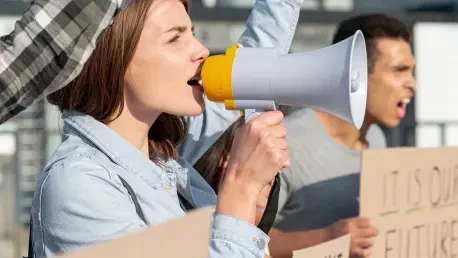

The conviction that a just society must silence harmful ideas to protect its most vulnerable members is gaining ground, creating a deep and perilous rift between the foundational values of free expression and equality. This growing tension challenges the bedrock of democratic discourse, forcing a difficult public conversation about the limits of tolerance and the nature of harm. At the heart of this debate lies a fundamental question: are the goals of inclusion and the principle of free speech locked in a zero-sum conflict, or can they coexist and even reinforce one another? As support for unfettered expression wanes in an era defined by political polarization and the rapid-fire outrage of social media, navigating this divide has become one of the most urgent civic challenges. This analysis explores the argument that these values are not only compatible but codependent, proposing a path forward that champions both without sacrificing either.
Defining the Central Conflict: Reconciling Foundational Values in a Polarized Era
This research addresses the escalating friction between the constitutional principle of free speech and the societal imperative of promoting equality and inclusion. It examines the central question of whether these two core values are destined for collision or can be reconciled as mutually reinforcing pillars of a healthy democracy. The analysis suggests that treating them as oppositional forces creates a false and dangerous dichotomy that ultimately undermines both. A society that curtails speech in the name of safety risks eroding the very tools needed to challenge injustice, while a society that ignores the harms of hateful expression fails to live up to its egalitarian ideals.
The core challenge identified is the significant erosion of principled, across-the-board support for free expression. In an environment of deep political division, the defense of speech has become conditional, often dependent on whose ideas are being protected. This selective commitment, amplified by social media platforms that reward performative outrage, weakens democratic norms and deepens public mistrust. When free speech is championed only for agreeable viewpoints, it ceases to be a universal principle and instead becomes another weapon in the arsenal of partisan warfare, jeopardizing the open dissent essential for societal progress.
The Widening Divide: Historical Context and Contemporary Urgency
The current climate of conditional support for free speech is not without precedent. Historically, commitment to the principle has often wavered, with groups across the ideological spectrum advocating for its protection only when it served their immediate interests. This research identifies this pattern of selective application as a significant long-term threat to democratic stability. When citizens perceive that the rules of discourse are applied unevenly, it fosters a pervasive sense of mistrust and delegitimizes the very idea of open debate, making it more difficult for any dissenting voice to be heard.
The urgency of this issue is magnified by a critical shift in where speech controversies now unfold. While historical debates often centered on government censorship and legal challenges, today’s most heated conflicts occur in private settings like university campuses, corporate workplaces, and online platforms. In these domains, the legal protections of the First Amendment have limited reach, leaving decisions about permissible speech to institutional policies and social pressure. This migration from the legal to the social sphere makes the cultivation of shared civic norms around discourse more critical than ever, as laws alone cannot sustain a culture of open inquiry.
Research Methodology, Findings, and Implications
Methodology
The analysis is structured around a pragmatic framework that integrates legal principles with historical context and contemporary civic practice. This approach moves beyond purely constitutional arguments to address the complexities of speech in modern society. It provides a practical guide for navigating ideological disagreements in real-world settings, from boardrooms to classrooms, with the goal of keeping difficult conversations productive rather than punitive.
A key element of this methodology is the distinction between two conceptions of free speech: the “negative right” and the “affirmative right.” The negative right, enshrined in the First Amendment, is the freedom from government interference. In contrast, the affirmative right to speak is a liberty that must be actively enabled by society through education, opportunity, and the cultivation of tolerant norms. Furthermore, the framework utilizes a structured analysis of hate speech, creating a taxonomy of speech-related harms. This approach carefully differentiates between the expression of offensive or injurious ideas and speech that constitutes a direct and imminent incitement to violence, arguing that only the latter warrants legal restriction.
Findings
A central finding of this research is that framing free speech and the pursuit of equality as a “zero-sum conflict” is a deeply flawed and counterproductive premise. On the contrary, the analysis concludes that the quest for a more diverse and inclusive society is fortified by a robust defense of free expression. Open discourse provides the most effective means for marginalized groups to advocate for their rights, challenge entrenched power structures, and persuade others of the justice of their cause. Suppressing speech, even with good intentions, ultimately disarms the very communities it aims to protect.
The research also highlights the general inefficacy and potential drawbacks of speech bans. Such prohibitions are often counterproductive, allowing purveyors of hateful ideologies to cast themselves as martyrs for free expression, which can attract sympathy and new followers. A more effective and democratic tool is “counterspeech”—the use of reasoned argument, evidence, and moral appeal to expose and discredit invidious ideas in the open. Moreover, a critical finding is the danger of politicizing free speech, which is increasingly viewed through a partisan lens. When liberals retreat from defending expression they find offensive, the principle becomes associated with conservative politics, weakening its standing as a universal democratic value essential for all.
Finally, the analysis confronts the complex issue of verbal harm, concluding that while words can undoubtedly wound, intimidate, and cause deep psychological distress, equating offensive speech with physical violence is a perilous mistake. This equivalence erodes crucial moral and legal boundaries, creating a dangerous justification for coercive or even violent retaliation against speakers. The framework maintains a clear distinction between ensuring physical safety, which is a societal obligation, and promising psychological safety from uncomfortable ideas, which is an untenable and undesirable goal for a pluralistic society.
Implications
The findings carry significant implications for both individual behavior and societal norms, pointing toward a model of shared responsibility. This includes a “duty of care” for speakers, particularly those in positions of authority, to consider the context, audience, and potential impact of their words. Simultaneously, it calls for a corresponding duty for listeners to resist reacting with “strict liability” to any perceived offense, urging them instead to consider intent and engage with ideas before rushing to judgment and punishment.
On a broader societal level, a primary implication is the urgent need to depoliticize the principle of free speech. This requires a concerted effort from leaders across the political spectrum to defend free expression as a non-partisan value, even—and especially—when it protects the speech of their ideological opponents. The most vital practical implication is a call to action for institutions and individuals to actively cultivate social norms that encourage open discourse, rigorous debate, and good-faith disagreement. Fostering these practices is not merely an academic exercise but an essential condition for maintaining a healthy and resilient democracy.
Reflection and Future Directions
Reflection
This research reflects on the profound challenge of implementing a principled, non-partisan defense of free speech in a hyper-polarized environment. In the current climate, both liberals and conservatives often retreat into ideological echo chambers, making the consistent application of free expression principles exceptionally difficult. The tendency to defend speech selectively remains a powerful obstacle to building the broad-based coalition necessary to protect open discourse for everyone.
Furthermore, the analysis acknowledges the inherent difficulty in applying the proposed framework for categorizing speech harms. The line between speech that is merely injurious to dignity and speech that directly instigates violence can be subjective and fiercely contested, leaving it vulnerable to manipulation in heated public debates. A key challenge identified is the need to overcome society’s growing inclination toward punitive outrage cycles, which are fueled by social media algorithms. These cycles stifle nuanced dialogue, discourage good-faith engagement on sensitive topics, and create a chilling effect that inhibits honest inquiry.
Future Directions
Future efforts should prioritize the development and promotion of educational initiatives in schools, universities, and workplaces. These programs must be designed to teach the practical skills of civil discourse, critical thinking, and effective counterspeech, equipping citizens with the tools to engage with differing viewpoints constructively rather than reflexively seeking to silence them.
Additionally, further research is needed to explore and implement practical models for restorative justice in response to speech-related transgressions. Instead of defaulting to purely punitive measures, which can entrench division, these models should emphasize accountability, learning, and forgiveness. Such an approach could help de-escalate conflicts and repair social fabric in a way that cancellation and public shaming cannot. A critical path forward also involves encouraging media organizations and institutional leaders to adopt standards that resist amplifying decontextualized, inflammatory rhetoric. Their focus should shift toward fostering more nuanced public conversations that reward complexity and reject the simplification inherent in outrage-driven narratives.
Conclusion: Embracing Democratic Tension as a Shared Responsibility
This analysis reaffirms that free speech and equality are not opposing forces but are, in fact, codependent pillars of a functional and just democratic society. Each provides necessary support for the other: free speech is the engine of social progress that allows for the critique of inequality, while the goal of equality ensures that all voices have a meaningful opportunity to be heard. Their perceived conflict is a product of a polarized culture, not an inherent incompatibility.
The most significant contribution of this work was its argument for moving beyond purely legalistic debates over the First Amendment and toward the much harder work of cultivating a civic culture of open, resilient, and responsible discourse. This required a shift in focus from what the law permits to what a healthy society should practice. It involved fostering norms of intellectual humility, a willingness to engage with dissent, and a shared commitment to resolving differences through dialogue rather than coercion.
Ultimately, the final perspective was that confronting hate, challenging inequality, and resisting the creep of authoritarianism demanded more speech, not less. The path to a more perfect union did not lie in the suppression of disagreement but in the active and shared practice of navigating democratic tension. It was through this difficult, ongoing, and often uncomfortable process of speaking and listening that a society could truly advance its highest ideals of freedom and fairness for all.