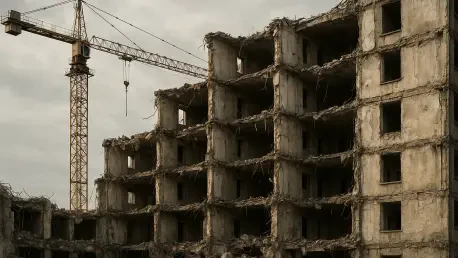

Since late 2024, approximately 3.5 million displaced persons have returned to find that their homes are legally insecure or have been designated for demolition. This stark reality underscores a critical turning point for the nation as the transitional government grapples with the monumental task of physical and economic rebuilding. While the shift toward recovery is a necessary step following years of devastating conflict, the current trajectory suggests a concerning prioritization of high-value real estate projects over the basic rights of ordinary citizens. Human Rights Watch has raised the alarm, pointing out that the national recovery plan unveiled in early 2026 lacks a robust, rights-based framework. The speed at which multibillion-dollar agreements are being signed with foreign investors stands in sharp contrast to the sluggish pace of legal reforms intended to safeguard the property of the displaced. Without a clear mechanism to adjudicate claims and protect the vulnerable, the reconstruction process risks entrenching the very injustices that the country seeks to leave behind. The focus on commercial feasibility over human dignity has created a landscape where the promise of a fresh start is increasingly reserved for the wealthy and the politically connected, leaving millions of others in a state of continued precariousness. This imbalance suggests that the rush to attract international capital is overshadowing the fundamental need for a fair and transparent system of resettlement and return.
The Economic Gap: Investment Pressures and Financial Realities
The primary theme identified in the current analysis is the staggering financial discrepancy between the actual cost of the damage and the funds currently available for rebuilding. Recent World Bank assessments from late 2025 indicated that the physical damage alone totaled approximately $108 billion, yet the total cost for comprehensive reconstruction is estimated to range between $140 billion and $345 billion. Despite high-profile pledges from regional powers, such as Saudi Arabia’s $6.4 billion commitment to the energy and real estate sectors and Qatar’s $4 billion pledge, the actual on-the-ground investment remains a mere fraction of what is truly required to restore national stability. This significant financial shortfall creates a high-pressure environment where the transitional government may be tempted to cut corners on human rights protections to retain fickle international capital. The drive to secure these multibillion-dollar deals often takes place behind closed doors, excluding the very people whose lives will be most impacted by these sweeping changes.
This environment of economic desperation incentivizes the government to prioritize speed and investor confidence over community consultation and legal reform. Human Rights Watch warns that the rush to attract foreign entities like the UAE-based DP World or various Saudi investment firms could lead to predatory practices where land is cleared for luxury developments without regard for existing ownership. In the absence of robust oversight and an independent judiciary, the drive for rapid physical rebuilding may entrench existing injustices rather than fostering a sustainable recovery that benefits the entire population. The pressure to present a modernized facade to the world often means that the needs of the rural poor and the urban displaced are pushed to the bottom of the list. By focusing so heavily on attracting capital, the government risks creating an economy that is structurally dependent on dispossession, where the physical reconstruction of cities is achieved through the legal and social exclusion of their former inhabitants.
Legal Legacies: The Persistence of Property Seizure Laws
A troubling continuity exists between the previous administration’s discriminatory laws and the current reconstruction projects being spearheaded by the transitional authorities. Specifically, legislative instruments such as Decree 66 of 2012 and Law No. 10 of 2018 remain deeply influential in the planning stages of new urban centers. These laws were historically used to seize property in areas perceived as informal or politically restive, often without providing adequate compensation or a practical means for displaced persons to prove their ownership. The Marota City and Basilia City projects in Damascus serve as prime examples of this trend, where luxury high-rises are being planned on land that was formerly home to thousands of middle-class and working-class families. Even under the current government, the legal status of these massive developments remains murky, leaving many original residents in a state of permanent displacement while their former neighborhoods are rebranded as high-end real estate ventures.
The persistence of these legal frameworks suggests that the transitional government has yet to fully break from the predatory property practices of the past. When residents are unable to produce original deeds because they were lost or destroyed during the conflict, the current system offers them almost no recourse. This legal vacuum allows developers to move forward with clearing large swaths of residential land under the guise of modernization and urban renewal. Human Rights Watch argues that unless these legislative instruments are completely overhauled and replaced with a system that prioritizes the rights of the dispossessed, the reconstruction process will effectively legalize the land grabs that occurred during the war. The rebranding of these areas as luxury hubs further complicates the return of original inhabitants, who find themselves priced out of their own communities or barred from returning by a maze of bureaucratic requirements. This trend reflects a broader strategy where law is used as a tool for demographic engineering rather than a shield for the vulnerable.
The Crisis of Return: Basic Services and Survival
Since the end of 2024, millions of refugees and internally displaced persons have returned to their communities, driven by a combination of rising costs in host countries and the expiration of international aid programs. However, Human Rights Watch emphasizes that the act of returning does not equate to true recovery. In many instances, those who make the journey back find their homes uninhabitable and their entire neighborhoods devoid of the basic infrastructure necessary for modern life. The village of Ghadafa in the Idlib countryside stands as a stark example of this crisis, where returning families struggle to survive without access to running water, electricity, or functioning sewage systems. Furthermore, the lack of medical facilities and schools in these rural zones makes it nearly impossible for families to establish a permanent and dignified presence, forcing many into a cycle of secondary displacement as they search for areas with better resources.
This uneven distribution of resources reveals a reconstruction strategy that heavily prioritizes profitable urban centers and strategic ports, such as Tartus, while neglecting the essential infrastructure required for sustainable living in residential and rural zones. By focusing on high-profit projects that appeal to international donors and private investors, the government is failing to provide the foundational services that are essential for the survival of the majority of the population. This neglect creates a two-tiered recovery where those in favored urban zones receive modern amenities while the rest of the country remains in a state of post-war ruin. The failure to restore water and electricity to returnee areas is not merely a logistical oversight; it is a policy choice that discourages the return of the poor and the marginalized. Without a shift in priorities that places basic human services at the center of the national recovery plan, the reconstruction of the country will remain an incomplete and deeply exclusionary process.
Marginalization: The Exclusion of Tenants and Informal Settlers
A particularly alarming finding in recent reports is the systematic exclusion of tenants and those living in informal settlements from the current recovery plans. Most reconstruction schemes prioritize registered landowners, leaving a massive segment of the pre-war population with little to no recourse. In proposed projects in areas like Jobar, for example, even registered homeowners are sometimes offered only 50% of their original floor area in new developments, while those in informal settlements receive a mere 30%. Most concerning is the total exclusion of tenants, who represent a significant portion of the urban population and are frequently offered no compensation or relocation assistance whatsoever. This approach threatens to create a permanent underclass of displaced persons who are structurally barred from participating in the national rebuilding effort, effectively erasing their history and their presence in the city.
This systematic marginalization is a form of demographic engineering that reshapes the social fabric of the country under the banner of urban planning. When reconstruction projects fail to recognize the rights of long-term tenants and informal dwellers, they are not just building new structures; they are actively dismantling existing communities. This approach turns the recovery process into a continuation of the conflict by other means, where the displacement caused by violence is made permanent by the displacement caused by development. Human Rights Watch concludes that physical rebuilding is meaningless if it excludes the people who were meant to live in those spaces. By ignoring the rights of those without formal titles, the government is ensuring that the benefits of reconstruction are concentrated in the hands of a small elite, while the millions who lived in the city’s outskirts and informal neighborhoods are left to fend for themselves in a landscape that no longer has room for them.
Pathways to Equitable Recovery: Recommendations for the Future
The analysis concluded that a sustainable recovery was only possible if the foundations were built on justice and participation rather than just concrete and capital. While the financial needs of the country remained staggering, the human cost of ignoring property rights and basic services was deemed far higher by international observers. The Syrian reconstruction deals, in their existing form, lacked the necessary safeguards to prevent a second wave of dispossession, and the findings served as a vital call to action for the international community to demand accountability before the cement dried on these multibillion-dollar projects. By prioritizing transparency, independent oversight, and the restoration of basic human services, the government and its partners had the potential to ensure that the new national landscape was a place where all citizens could finally return home. Success in this endeavor required a steadfast commitment from donors and investors to hold the transitional government to the highest possible standards of international law and human dignity.
The final assessments emphasized that the transitional government was urged to create a legal framework that mandated community consultation and established an independent grievance mechanism for property claims. Organizations like the World Bank and the European Union were encouraged to make the disbursement of their billions in aid contingent on strict compliance with human rights standards. Furthermore, private investors were advised to conduct thorough human rights due diligence to ensure that their developments did not facilitate further displacement or profit from discriminatory laws. By shifting the focus away from high-value real estate and toward the restoration of schools, healthcare, and water systems in returnee areas, the government could have transitioned from a model of predatory reconstruction to one of inclusive recovery. The message was clear: the future of the nation depended on whether the rules of the rebuilding process recognized the voices and the rights of all its people, rather than just those with the capital to buy into it.