
A halt in construction on a project of immense scale does not simply mean idle machinery; for one offshore wind developer, it translated into a staggering financial hemorrhage of fifty million dollars for every week the cranes stood still. This figure represents more than a line item on a balance sheet; it is the tangible cost of a political war waged against an industry once heralded as a cornerstone of America’s clean energy future. The battle over towering turbines at sea has become a potent symbol of a larger conflict, where long-term infrastructure investment collides with the volatile four-year cycle of presidential power, leaving a trail of broken deals and shattered investor confidence.
When a Stop-Work Order Costs $50 Million a Week
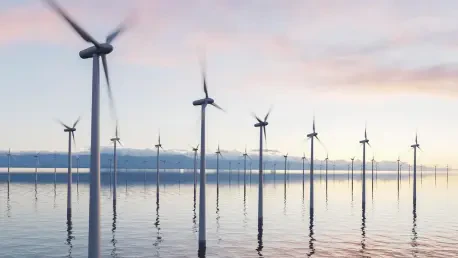
The immediate consequences of a federal permitting freeze are not abstract; they are measured in real dollars and delayed progress. When the administration issued a sudden stop-work order on the Empire Wind project off Long Island, its developer, Equinor, began losing an estimated $50 million weekly. This wasn’t merely a pause but a direct financial assault that threatened the viability of a multi-billion dollar investment. Similarly, a monthlong stoppage on the Revolution Wind project, situated south of New England, cost its developers a reported $70 million, demonstrating the immense financial leverage wielded by a hostile executive branch.
These actions created a chilling effect that rippled through the supply chain and among financial backers. The abrupt halts were not based on new environmental findings or technical failures but on a clear political directive. This transformed standard project management into a high-stakes gamble, where the primary risk was not geological or logistical but political. For companies that had already invested hundreds of millions in development, manufacturing, and vessel contracts, such an unpredictable interruption represented a catastrophic liability.
The Promise and Peril of America’s Offshore Ambitions
Only a few years ago, the U.S. offshore wind sector was a beacon for global capital, attracting billions in investments with the promise of powering millions of homes and establishing American leadership in a next-generation energy market. Backed by ambitious federal targets and lucrative tax credits from the Inflation Reduction Act (IRA), the industry was on a rapid ascent. It was positioned as a critical component of the nation’s strategy to achieve energy independence while simultaneously combating climate change, creating a new domestic manufacturing base in the process.
However, this high-profile growth and its association with the previous administration’s climate agenda made it a prime political target. The assault on offshore wind became intrinsically linked to a broader campaign to dismantle the IRA and roll back clean energy initiatives. The industry’s reliance on federal permits for seabed leasing and construction provided a direct lever for the executive branch to apply pressure. Consequently, the very policies designed to foster its growth inadvertently painted a target on its back, turning a story of economic promise into one of political peril.
Anatomy of the Assault a Multi-Front War
The campaign against offshore wind was not a blanket policy shift but a series of precise and targeted actions designed for maximum disruption. The primary weapon was the administrative power to freeze permits and issue stop-work orders, a tactic that exploited the industry’s long development timelines and high capital costs. This strategy created immediate financial bleeding, as seen with the Empire Wind and Revolution Wind projects, but the true goal appeared to be a more permanent dismantling of the industry’s foundation in the United States.
The most profound impact has been the erosion of investor confidence. Global energy giants, which require stable and predictable regulatory environments for their decades-long investments, now view the U.S. market with extreme caution. Executives from Ørsted and EDP Renewables have publicly stated their intent to de-prioritize American projects, shifting focus toward the more politically stable markets in Europe and Asia. The concept of the “four-year presidential window” has entered the industry’s lexicon as an unmanageable risk, with one executive noting it is now nearly impossible to guide a project from conception to operation without fearing an arbitrary political intervention. This specific and intense focus on offshore wind, more so than on onshore solar or wind, suggests a calculated effort to cripple a highly visible symbol of the green energy transition.
A House Divided the Industry’s Fractured Defense
Faced with an existential threat, the renewable energy sector’s response was not a unified charge but a fractured and hesitant maneuver, revealing deep strategic divisions. A rift quickly emerged between companies willing to engage in direct confrontation and those who favored quieter, back-channel negotiations. This was starkly illustrated when developer Ocean Winds joined a multi-state lawsuit against the administration’s permitting freeze, while most other major players chose to pursue individual diplomatic efforts to protect their substantial investments.
This disunity was most evident within the American Clean Power Association (ACP), the industry’s primary trade group. Representing solar, battery, and onshore wind interests alongside offshore, the ACP found itself on a political tightrope. Its leadership was reluctant to wage an aggressive legal war over offshore wind, fearing it would alienate moderate Republicans whose support was deemed essential to protect the IRA’s broader clean energy tax credits for the entire sector. In a notable case, Norwegian state-owned Equinor leveraged its dual identity as both a renewable developer and a major oil and gas operator to negotiate a controversial deal. It allegedly secured the lifting of the stop-work order on its Empire Wind project in exchange for cooperation on new natural gas pipelines, demonstrating the complex and often compromising bargains struck in the name of survival.
The New Survival Playbook for a Volatile Market
The crisis has fundamentally reshaped how energy companies approach the American market, forcing the creation of a new playbook for navigating extreme political risk. The first chapter of this playbook is geographic diversification. Following the lead of global energy firms, companies are actively de-risking their portfolios by shifting investment focus to regions with more predictable regulatory frameworks, such as Europe and Asia, thereby reducing their exposure to American political volatility.
Another key strategy involves a delicate cost-benefit analysis of political bargaining. Companies are now forced to weigh the immediate advantages of direct, high-level negotiations against the long-term risk of compromising on core environmental principles or other strategic objectives. Finally, the fragmented response to the assault highlighted a critical vulnerability. There is a growing recognition across the sector that a unified front is not just preferable but essential. The experience taught a harsh lesson: when an industry fails to stand together, its individual members can be isolated and targeted one by one, making solidarity a matter of collective survival.
The aggressive and targeted campaign against the U.S. offshore wind industry served as a stark demonstration of how executive power could be used to derail a burgeoning sector. The financial damage was immediate and immense, but the long-term erosion of investor confidence created a far more lasting scar. The industry’s fractured defense, born from competing interests and strategies, underscored its vulnerability. What remained was a cautionary tale for any capital-intensive industry operating at the intersection of policy and politics, and a new, more cautious reality for the future of large-scale infrastructure in a polarized nation.