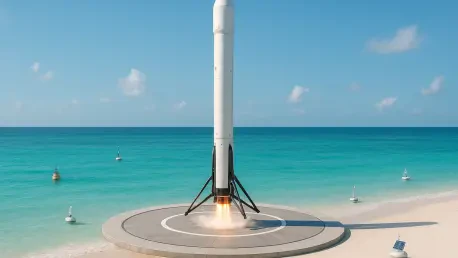

The relentless thundering of orbital class rockets across the Florida coastline has transformed a once-quiet wildlife sanctuary into a high-octane industrial theater where national security and private profit now collide with federal law. The commercial space industry is no longer a peripheral experiment but the primary engine of the U.S. aerospace sector. As NASA pivots its resources toward deep-space exploration and lunar habitats, private corporations have stepped in to manage the logistical heavy lifting of low-Earth orbit. This shift marks a fundamental change in how the federal government interacts with orbital operations, moving from a role of direct management to one of oversight and licensing. The strategic reliance on companies like SpaceX, Blue Origin, and United Launch Alliance has made the rapid approval of launch licenses a matter of national economic urgency.
Florida’s Space Coast serves as the epicenter of this industrial boom, providing the geographic and logistical infrastructure necessary for global dominance in launch and reentry services. The region has become a dense cluster of manufacturing, testing, and launch facilities that support both government and private payloads. However, this concentration of activity creates a unique tension between the mission of national security and the commercial ambitions of global conglomerates. The Federal Aviation Administration (FAA) now finds itself at the center of a debate over whether traditional regulatory frameworks can keep pace with the sheer volume of scheduled launches. Balancing the need for rapid deployment with the responsibility of protecting public resources remains the most significant challenge facing the industry in 2026.
The New Frontier: Navigating the Commercial Space Industry’s Rapid Expansion
The aerospace landscape is currently defined by a decisive transition toward private enterprise, where the speed of innovation often outstrips the pace of federal rulemaking. Major market players have shifted from being mere contractors to becoming the primary architects of American orbital infrastructure. SpaceX continues to lead in launch frequency, while Blue Origin and United Launch Alliance are scaling operations to support massive satellite deployments and lunar logistics. This maturation of the private sector has necessitated a more streamlined approach to federal oversight, as the line between commercial success and national security interests becomes increasingly blurred.
Florida’s Merritt Island and the surrounding Cape Canaveral area have solidified their status as the global hub for sophisticated launch and reentry operations. This strategic significance is rooted in the existing infrastructure and the unique geographical advantages that allow for high-cadence launch schedules. However, as the industry expands, the intersection of federal oversight and commercial ambition has created a bottleneck. The current regulatory environment was designed for an era when launches were infrequent events, rather than the weekly or daily occurrences that define the present market.
Evolution and Economic Velocity: Trends and Projections in Modern Rocketry
Innovation and Influence: Emerging Technologies Reshaping Space Operations
The rise of reusable launch vehicles has fundamentally altered the economics of space, making frequent access to orbit a sustainable business model rather than a taxpayer-funded luxury. By successfully landing and refurbishing boosters, companies have drastically reduced the per-kilogram cost of payload delivery. This operational frequency is further driven by evolving consumer and corporate behaviors, particularly the global demand for massive satellite constellations that provide low-latency internet and real-time earth observation. These constellations require a constant cycle of launches to maintain and upgrade orbital hardware, creating a self-sustaining demand for launch services.
Modern engineering techniques such as digital twins and rapid prototyping are further accelerating the pace of the space race. These technologies allow companies to simulate flight conditions and test hardware iterations in virtual environments before physical production, cutting years off traditional development cycles. Beyond simple satellite deployment, new opportunities are emerging in orbital manufacturing and high-end space tourism. These sectors represent the next phase of economic growth, where microgravity environments are utilized for pharmaceutical research and advanced materials production, further complicating the regulatory requirements for safe and frequent reentry.
Assessing Growth: Market Performance and Forward-Looking Projections
Current market data indicates that launch cadences have reached unprecedented levels, with industry valuation reflecting a robust investor confidence in long-term orbital infrastructure. The economic impact of streamlined licensing is projected to be substantial, potentially adding billions to the national aerospace economy by 2028. As the FAA considers reducing bureaucratic hurdles, the projected increase in private investment suggests that the industry is poised for an era of exponential growth. Forward-looking performance indicators, tied to both private capital and long-term government contracts, show a sector that is increasingly vital to the broader technological economy.
Global competition plays a pivotal role in dictating the pace of U.S. regulatory changes. With international rivals developing their own heavy-lift capabilities and streamlined launch corridors, American policymakers are under pressure to ensure that domestic regulations do not drive innovation offshore. The current projections assume a regulatory environment that can adapt to high-frequency operations without sacrificing safety. If the licensing process remains static while the technology advances, the resulting friction could lead to missed economic opportunities and a decline in the competitive edge that the United States currently holds in the global marketplace.
Balancing Velocity and Responsibility: Identifying Core Industry Obstacles
The primary obstacle cited by industry leaders is a permitting system that many describe as outdated and inefficient. High costs associated with bureaucratic delays can stall projects for months or even years, leading to significant financial losses for private investors. This tension is particularly acute on the Space Coast, where industrial growth must coexist with a thriving eco-tourism sector. The Merritt Island National Wildlife Refuge, which surrounds many launch complexes, serves as a reminder that the same land used for cutting-edge rocketry is also home to fragile ecosystems that attract millions of visitors and support local livelihoods.
Managing the risks to these ecosystems requires a sophisticated approach that the current regulatory framework may lack. Endangered species and protected habitats are frequently in the direct flight path of debris and noise pollution, leading to constant friction between conservationists and aerospace engineers. Modernizing the regulatory framework involves more than just speed; it requires a strategy that integrates environmental integrity into the engineering process. Without such a balance, the industry risks a public backlash that could lead to even more restrictive legislation in the future.
The Regulatory Flashpoint: Evaluating the FAA’s Proposed Environmental Waivers
The debate reached a fever pitch following a 2025 executive order that proposed granting the Secretary of Transportation the authority to suspend thirteen federal statutes for space operations. This proposal targets foundational laws such as the National Environmental Policy Act (NEPA) and the Endangered Species Act (ESA), which have long been the primary tools for mitigating the environmental impact of industrial projects. Proponents argue that these waivers are necessary to maintain the pace of the space race, while critics view them as a dangerous expansion of executive authority that could bypass essential legal protections.
The legal and constitutional implications of such a move are profound, as it challenges the standard process of environmental review. Laws like the Clean Water Act and the Marine Mammal Protection Act are critical for maintaining the health of the Indian River Lagoon, a vital estuary that has already suffered from industrial runoff. If these protections are sidelined, the long-term health of the region’s water and wildlife could be compromised. This regulatory flashpoint represents a fundamental question: does the strategic importance of space exploration justify the relaxation of the laws that protect the nation’s natural heritage?
Charting the Path Forward: Innovation and Policy in the Next Decade
Predicting the impact of these regulatory shifts requires a look at how innovation responds to policy constraints. If the FAA moves forward with categorical waivers, it may spark a short-term surge in launch activity, but it could also lead to protracted legal challenges that create more uncertainty for the industry. A more nuanced reform might involve the creation of specialized environmental standards specifically tailored for aerospace operations, rather than a total exclusion from existing laws. Such a compromise would allow for faster permitting while still requiring companies to account for their ecological footprint.
Emerging environmental monitoring technologies, such as AI-driven acoustic sensors and real-time water quality trackers, offer a middle ground for compliance. These tools could provide the data necessary to prove that launches are not causing irreparable harm, allowing for a more data-driven approach to regulation. The long-term influence of public sentiment cannot be ignored, as community advocacy groups in Florida and beyond continue to demand transparency. A sustainable path forward will likely involve a combination of smarter technology and a policy framework that values both the reach for the stars and the preservation of the earth.
Finding Common Ground: Recommendations for a Sustainable Space Future
The investigation into the FAA proposal revealed a complex landscape where the desire for rapid progress stood at odds with established environmental safeguards. It was found that a blanket waiver of federal statutes risked creating significant ecological debt that future generations would be forced to repay. Regional stakeholders emphasized that the recovery of the Indian River Lagoon represented a multi-million-dollar public investment that should not have been jeopardized by industrial exemptions. The analysis showed that while the permitting system required modernization, the total suspension of oversight was an extreme measure that lacked broad public support.
Legislators and industry leaders suggested a transition toward a more adaptive regulatory model. This model prioritized high-frequency monitoring and automated compliance checks over lengthy narrative reports. It was determined that national security and environmental health were not mutually exclusive goals, but rather two pillars of a stable and prosperous aerospace sector. Ultimately, the industry moved toward a framework that rewarded companies for integrating sustainable practices into their launch profiles. This approach ensured that the United States remained a global leader in innovation while maintaining its commitment to the responsible stewardship of its natural resources.