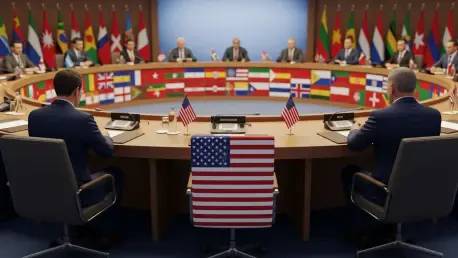

In a move that reverberated across global diplomatic circles, the United States formally initiated its departure from the foundational treaty that has guided international climate action for over three decades, charting a solitary course away from a consensus it once helped build. The decision to exit the 1992 United Nations Framework Convention on Climate Change (UNFCCC) makes the U.S. the only country among 198 signatories to ever renounce the pact, a landmark action that isolates the nation and signals a profound shift in its approach to international environmental governance. This withdrawal represents a significant escalation of the Trump administration’s efforts to unravel climate policies, moving beyond the first-term departure from the 2015 Paris Agreement to dismantle the very bedrock of global climate cooperation.
From Champion to Outcast: An Unprecedented Reversal
The United States now stands alone on the world stage, a stark contrast to its historical role as a primary architect of global climate policy. Thirty-four years ago, under President George H.W. Bush, the U.S. became the first industrialized nation to ratify the UNFCCC, a treaty that garnered nearly universal participation and laid the groundwork for decades of international negotiations. Today, its withdrawal leaves a vacuum in global leadership, positioning the country as an outlier in a critical area of international concern. The move effectively sidelines the U.S. from formal climate discussions and negotiations, ceding influence to other global powers.
This decision marks a dramatic reversal of a long-standing, if at times inconsistent, bipartisan legacy. For decades, both Democratic and Republican administrations engaged with the UNFCCC framework, viewing it as the essential forum for addressing climate change. The current administration’s action abandons this tradition, reframing international climate cooperation not as a strategic necessity but as a threat to national interests. This departure from a bipartisan consensus underscores a fundamental realignment of American foreign policy and its relationship with multilateral institutions.
The Rationale Behind the Retreat: Sovereignty, Economics and Ideology
The administration’s justification for the withdrawal is rooted in an “America First” doctrine that prioritizes national sovereignty and economic independence above international commitments. According to a White House fact sheet, the UNFCCC and its associated bodies promote “radical climate policies, global governance, and ideological programs” that are viewed as being in direct conflict with American economic interests. This perspective casts the treaty not as a tool for collective problem-solving but as an infringement on the nation’s ability to chart its own course without external constraints.
This position was articulated by Secretary of State Marco Rubio, who asserted that the UNFCCC is one of 66 international organizations the U.S. is leaving because they actively seek to “constrain American sovereignty.” Citing issues such as gender equity campaigns and “climate orthodoxy” as examples, Rubio declared an end to funding institutions that, in his view, provide little tangible benefit to the United States. He emphasized that the “blood, sweat, and treasure of the American people” would no longer support international bodies perceived as undermining domestic policy and American values.
A Deliberate Dismantling: The UNFCCC Exit in Broader Context
The withdrawal from the UNFCCC is not an isolated act but the culmination of a broader, systematic campaign to dismantle climate policy at every level. Domestically, the administration has aggressively erased regulations governing climate pollution from power plants and vehicles, reversing key initiatives from the previous Biden administration. This domestic rollback is complemented by a concerted effort to sideline established science, including a withdrawal from the Intergovernmental Panel on Climate Change (IPCC) and the recruitment of climate contrarians to produce reports aimed at discrediting mainstream scientific consensus.
This new agenda extends aggressively into foreign policy. While the U.S. was absent from the recent COP30 climate talks in Brazil, it has actively pursued international fossil fuel deals. In a dramatic example of this shift, the administration deployed military force to seize control of Venezuela’s oil resources following the capture of its leader. Delta Merner of the Union of Concerned Scientists noted that walking away from the IPCC “doesn’t make the science disappear” but instead leaves American policymakers and businesses dangerously uninformed at a critical moment.
A Chorus of Condemnation: Expert Voices on the Fallout
The decision has elicited a torrent of criticism from former officials, environmental groups, and policy experts, who describe it as a shortsighted abdication of American leadership. Former EPA Administrator Gina McCarthy called the move “embarrassing, and foolish,” while former U.S. climate envoy Todd Stern lamented the abandonment of a leadership role that was instrumental in creating both the UNFCCC and the Paris Agreement. Sue Biniaz, a former deputy climate envoy, argued that the U.S. has compelling economic, environmental, and geopolitical reasons to lead on climate rather than surrendering its influence to other nations.
Experts also issued dire warnings about the long-term economic and environmental consequences of this self-imposed isolation. Amanda Leland of the Environmental Defense Fund stated that the U.S. would set back its own families and businesses, exposing them to “dirtier air, worse health outcomes, pay higher energy bills,” and a missed opportunity to lead the global clean energy transition. This sentiment was echoed by David Waskow of the World Resources Institute, who labeled the withdrawal a “strategic blunder that gives away American advantage for nothing in return.” For many, the decision is seen not only as an environmental misstep but as an act of economic self-harm.
The Path Ahead: Legal Battles and the Future of US Climate Policy
The formal process for withdrawal is straightforward: the exit will become official one year after the U.S. submits its formal request to the United Nations. However, the path to potentially rejoining the treaty is far less clear and is the subject of significant legal debate. Since the U.S. Senate unanimously ratified the pact 34 years ago, some scholars, like Professor Jean Galbraith, argue that a future president could unilaterally rejoin, contending that a single administration should not be able to permanently nullify a Senate-ratified treaty. Others maintain that reentry would require a new Senate vote, a politically challenging prospect.
While the majority of voices have been critical, a contrarian perspective exists. George David Banks, who served as an international climate adviser during Trump’s first term, dismissed the UNFCCC as “a joke” and suggested the U.S. withdrawal could force the international community to rethink its approach. Despite this view, even Banks has advocated for continued U.S. engagement in international climate discussions to ensure global policies do not “undermine the economic value of U.S. fossil fuels.” This complex landscape of legal uncertainty and competing policy visions has left American businesses and diplomats navigating a new and unpredictable reality, one where the nation’s future role in global climate action remains profoundly uncertain.
The decision to withdraw from the UNFCCC was presented as a definitive step toward reclaiming national sovereignty, but in doing so, it created a legacy of international isolation and raised fundamental questions about the future of American leadership. This action set in motion a series of legal and diplomatic challenges that will likely take years to resolve, leaving both domestic and international stakeholders to grapple with the consequences of a world where the United States chose to stand apart from a global consensus it once championed. The long-term impacts on the nation’s economy, environmental health, and geopolitical standing became the central debate for policymakers and citizens alike.