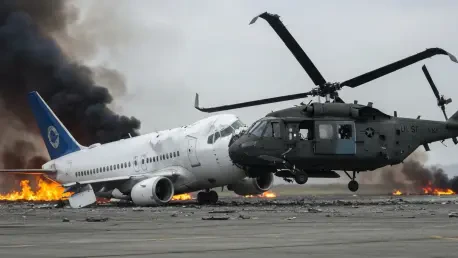

What happens when the bustling airspace above a nation’s capital becomes a stage for tragedy? On a chilling January morning this year, the skies over Washington, D.C., bore witness to a catastrophic midair collision between American Eagle Flight 5342 and a U.S. Army Black Hawk helicopter. The devastating impact claimed 67 lives, sending shockwaves through the nation as wreckage plunged into the Potomac River near Ronald Reagan Washington National Airport. This disaster, unfolding in one of the most tightly controlled airspaces in the world, has left families shattered and a country grappling with urgent questions of safety and accountability.
The Weight of a National Tragedy
Beyond the raw numbers, this collision strikes at the heart of public trust in aviation safety. Washington, D.C., with its restricted airspace and stringent security measures, should be a fortress against such disasters. Yet, the incident exposes potential vulnerabilities in a system relied upon by millions. It’s not just about the lives lost on that fateful day; it’s about what this means for every passenger boarding a plane or every military operation sharing the skies. As lawsuits mount, the nation watches, seeking answers to prevent history from repeating itself in other crowded airspaces.
Unraveling the Day of Disaster
The morning of January 29 began like any other, with flights buzzing near the capital and military operations seamlessly integrated into the airspace. But in a matter of seconds, chaos erupted as the civilian airliner and military helicopter collided midair. Eyewitness accounts describe a deafening roar followed by a haunting silence as debris rained down. Recovery teams worked tirelessly along the Potomac, retrieving fragments of lives lost—each piece a somber reminder of the scale of this catastrophe. The human cost, etched into the memories of surviving families, fuels a relentless pursuit for clarity on how such a failure occurred.
Technical Failures or Human Error?
As investigations continue, attention turns to the complex interplay of technology and human oversight in D.C.’s airspace. Could a glitch in radar systems have masked the approaching danger? Or did communication breakdowns between civilian air traffic control and military channels create a fatal blind spot? Historical cases, like the 1996 midair collision over India, often point to systemic lapses in coordination. Experts suggest that with the unique pressures of this region—where security and traffic intersect—any minor error can escalate rapidly. The truth remains elusive, but these questions are vital to understanding the root of this tragedy.
Legal Storm on the Horizon
The aftermath has ignited a fierce legal battle, with wrongful-death claims filed against American Airlines and the federal government. Represented by prominent firms like Kreindler & Kreindler and Williams & Connolly, grieving families demand not just compensation but systemic change. A jury trial, scheduled for April 2027 under U.S. District Judge Ana C. Reyes, promises to dissect every detail of that tragic day. Meanwhile, American Airlines and PSA Airlines, defended by Holland & Knight, brace for intense scrutiny, while government attorneys maintain a stoic silence. This clash in courtrooms will likely shape accountability standards for years to come.
Voices Echoing Pain and Expertise
Amid the legal filings, raw emotion pours from those directly affected. A plaintiff’s plea, widely shared across media, cuts deep: “No amount of money can bring them back, but knowing why this happened might save others.” Aviation safety analysts weigh in as well, highlighting the exceptional challenges of D.C.’s airspace. One expert noted, “This zone is a pressure cooker—perfect coordination isn’t just ideal, it’s essential.” These perspectives, blending personal grief with professional insight, paint a vivid picture of a tragedy that transcends individual loss, pointing to broader flaws in need of urgent attention.
Charting a Path Forward
Looking ahead, the road to resolution demands patience and action from all corners of society. The prolonged wait for the 2027 trial means families must endure years of uncertainty, but staying engaged with public hearings and preliminary reports can offer some solace. Advocacy for enhanced safety measures, such as tighter civilian-military flight protocols and upgraded air traffic control tech, must gain momentum now. Community support also plays a crucial role—whether through memorial funds or mental health resources, ensuring the 67 lost are remembered keeps their legacy alive. The nation stands at a crossroads, with an opportunity to transform this heartbreak into lasting reform.
In reflecting on that devastating January day, the nation mourned not just the 67 souls lost but also the illusion of impenetrable safety over its capital. The legal battles that unfolded revealed deep-seated complexities in assigning blame amid tangled systems of oversight. Yet, from the wreckage salvaged along the Potomac emerged a collective resolve to demand better—stronger protocols, clearer communication, and unwavering accountability. As the trial looms two years ahead, continued public pressure and innovative safety reforms remain critical to honor the fallen by safeguarding the skies for future generations.