
Desiree Sainthrope is a legal heavyweight whose career has been defined by the intricate dance between trade agreements and regulatory compliance. Today, she sheds light on the regulatory storm brewing in New Jersey, where a series of egregious environmental violations at fuel stations have sparked a massive crackdown. We dive into the complexities of underground storage tank compliance, the legal weight of $50,000 penalties, and the ripple effects when high-profile investments collide with state law.
State regulators have identified nearly 200 regulatory violations at certain retail fuel stations, including operating without permits. How do these recurring failures impact the integrity of environmental oversight, and what does it reveal about the challenges of enforcing compliance in the energy sector?
The discovery of 196 separate violations since 2022 represents a systemic breakdown in the culture of safety that we expect from the energy sector. When the Department of Environmental Protection labels these issues as “major,” they are signaling that the risk of soil and water contamination is an imminent danger rather than just a theoretical threat. I see the situation in Burlington County, where a station was found operating without a valid air permit as recently as July 8, as a clear indicator of how some operators view regulations as mere suggestions. It is incredibly jarring for regulators to watch these facilities “repeatedly, significantly and substantially” fail to comply, even after previous enforcement actions were supposed to have corrected the behavior.
When a station faces a delivery ban—often described as a ‘kiss of death’—yet continues to operate by cutting seals and bypassing restrictions, what are the broader legal and financial ramifications for the network involved?
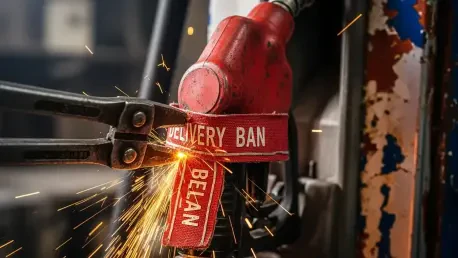
A delivery ban is intended to be the ultimate deterrent, a cold reality where the pumps run dry and the business essentially ceases to exist until repairs are verified. To see a station in Atlantic County deliberately cut the regulatory seal to fill their unregistered tanks is an act of defiance that shifts the case from simple negligence into the realm of willful misconduct. The resulting $50,000 penalties handed out to multiple stations are not just a slap on the wrist; they are a significant financial blow meant to signal that the state’s authority cannot be physically severed with a pair of bolt cutters. These actions create a toxic paper trail of non-compliance that can haunt a company’s valuation, especially when penalties from a May order remain unpaid months later, casting a long shadow over their operational legitimacy.
Given that some of these stations are linked to the Freedom Fuel network and have been publicly highlighted by high-profile figures, how does public visibility complicate the regulatory process and the scrutiny from the Attorney General’s Office?
The intersection of politics and petroleum creates a high-pressure environment where every social media post or public video, like those shared on July 1 and July 7, acts as a megaphone that invites regulators to look even closer. When you have a network associated with massive investment entities like Blue Owl, which manages over $300 billion in assets, the legal stakes transition from local zoning issues to serious global compliance concerns. The New Jersey Attorney General’s Office is now looking beyond just storage tanks, conducting inspections to ensure they are not illegally selling gas below cost. This “fishbowl” effect is likely why a station in Camden County was hit with a delivery ban on July 9, proving that political spotlighting is often a double-edged sword that attracts both customers and compliance officers.
What is your forecast for the future of regulatory compliance within these large-scale retail fuel networks?
My forecast is that we are entering an era of “hyper-compliance” where the margin for error will be nonexistent for high-visibility fuel networks. The state has already shown its hand by issuing nearly 200 violations and heavy $50,000 fines, suggesting that they will move toward even more aggressive sealing tactics and permanent shutdowns if the pattern of defiance continues. We will likely see a massive internal audit across all Freedom Fuel sites to address the unregistered tanks and air permit lapses before the Attorney General’s price-related investigation gains more steam. Ultimately, the industry must realize that while inexpensive gas might win public favor, it cannot be sustained by cutting corners on environmental safety and state law.