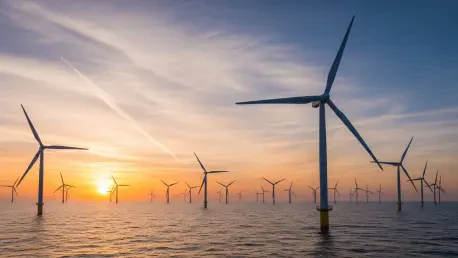

An unprecedented clash between executive will and judicial review is unfolding along the Atlantic coast, where the fate of a multi-billion-dollar renewable energy industry hangs precariously in the balance. The Trump administration, propelled by the president’s vocal antipathy toward wind power, has unleashed a concerted campaign to halt the construction of massive offshore wind farms, only to be repeatedly blocked by the very legal system it sought to leverage. This high-stakes confrontation raises a fundamental question about the limits of presidential power when confronted with the rule of law, with the future of American energy policy and international investment confidence caught in the crossfire.
When a President’s Personal Animus Meets the Rule of Law
The central conflict tests the boundaries of executive authority when it appears to be driven by personal conviction rather than established policy. President Donald Trump has never concealed his disdain for wind turbines, frequently branding them as “losers” and an aesthetic blight. This long-standing personal animus has now transformed into official government action, as his administration attempts to use the levers of federal power, including national security protocols, to bring the burgeoning offshore wind industry to a grinding halt. The core of the issue becomes whether such executive actions, rooted in a leader’s public statements of opposition, can withstand judicial scrutiny when their legal foundations are challenged.
This dynamic has set the stage for a direct confrontation between the executive branch and the judiciary. In a decisive move, the Trump administration’s Interior Department issued stop-work orders for all five large-scale offshore wind projects under construction, triggering an immediate and forceful legal response from developers who have invested billions. The ensuing court battles have become a critical proving ground, pitting the administration’s claims of national security against the industry’s arguments of arbitrary and capricious government overreach. The consistent rulings from federal courts against the administration suggest a clear judicial check on executive actions that lack a reasoned and defensible basis.
The Stakes: Billions Invested, A Green Agenda Halted
Before the administration’s intervention, the U.S. offshore wind sector was on a trajectory of significant growth, buoyed by momentum from the previous administration and substantial private investment. Companies had committed vast sums of capital, secured complex supply chains, and chartered specialized vessels for construction, all in service of a green energy agenda aimed at diversifying the nation’s power grid and reducing carbon emissions. This progress was abruptly jeopardized when the full weight of the executive branch was directed at stopping these projects in their tracks.
The campaign to stall the industry has been multifaceted, with its origins clearly tied to President Trump’s public rhetoric. His characterization of wind power as the “scam of the century” provided the political backdrop for a series of administrative actions designed to undermine projects approved by his predecessor. This broader strategy reflects a general hostility toward renewable energy initiatives and efforts to address climate change, positioning the offshore wind industry as a prime target in a larger political and ideological battle over the future of American energy.
The formal justification for this sweeping action came in December, when the Interior Department issued its stop-work orders, citing undisclosed national security concerns. A White House spokesperson, Taylor Rogers, defended the move, stating the administration’s priority is to “put America First and protect the national security of the American people,” and expressed confidence in an “ultimate victory on the issue.” For the developers, who were already engaged in the logistically demanding process of offshore construction, this sudden directive represented not just a policy shift but an existential threat to their investments, prompting them to immediately turn to the courts for relief.
A Triad of Judicial Defeats
The legal showdown that followed the administration’s stop-work orders resulted in a series of decisive and rapid defeats for the government. Developers, armed with arguments of irreparable economic harm and a lack of due process, challenged the federal government in court and secured a “clean sweep” of victories. In three separate cases, federal judges, remarkably appointed by presidents from three different political eras, all sided with the wind proponents, lifting the stop-work orders and allowing construction to resume.
The first major blow to the administration’s strategy came from Judge Carl Nichols, a Trump appointee, in the case concerning New York’s Empire Wind project. He found that the government’s lawyers failed to provide a compelling response to the developer’s arguments and determined that the vague national security claims were insufficient to justify the tangible and severe harm of a complete work stoppage. Shortly after, Judge Royce Lamberth, a Reagan appointee, ruled against the administration in the challenge to the Revolution Wind project. His decision pointedly highlighted the pretextual nature of the government’s reasoning, noting public interviews where Interior Secretary Doug Burgum cited costs and wildlife impacts—factors “unrelated to national security”—as the real drivers of the opposition.
The third and final ruling came from Judge Jamar Walker, a Biden appointee, in the case involving Dominion Energy’s Coastal Virginia Offshore Wind project. While acknowledging the judiciary typically gives heavy deference to the executive branch on matters of national security, Judge Walker concluded that the “evidence does not demonstrate the security risk is so imminent” as to warrant such a drastic measure as a full construction halt. This trio of rulings from a diverse set of judicial appointees sent a powerful message about the weakness of the administration’s legal position.
Voices of Analysis: “Forced to Cut Corners with Its Reasoning”
Legal experts largely agree that the administration’s overt hostility toward the industry ultimately doomed its legal strategy. Joel Eisen, a law professor at the University of Richmond, analyzed the situation, concluding that the administration’s clear “animus” for these projects “forced it to cut corners with its reasoning.” He argued that this bias blinded officials to the fundamental requirements of administrative law, which mandate that the government provide a well-supported and rational explanation for its actions. The failure to meet this basic standard was the common thread in the courts’ rejections.
The fact that judges appointed by Presidents Trump, Reagan, and Biden all arrived at the same conclusion is particularly significant. It underscores that the rulings were not based on partisan alignment but on a shared interpretation of administrative law and the government’s failure to present a credible case. This cross-ideological consensus from the judiciary has substantially weakened the administration’s claim that its actions were based on legitimate national security concerns rather than political motivations.
The judicial rebukes have been amplified by strong reactions from political figures. “Trump is getting his butt kicked again,” remarked Rep. Scott Peters, arguing the court decisions prove the administration’s actions are illegal. Beyond the domestic political fray, some have voiced concern over the international implications. Sen. Lisa Murkowski warned that such unpredictable executive actions risk damaging the reputation of the United States as a stable and reliable destination for long-term international investment, pointing to the involvement of Danish developer Ørsted in two of the targeted projects.
The Strategy of Uncertainty: A Pyrrhic Victory for Developers?
Despite the string of legal victories, the administration’s campaign may still achieve a more subtle, long-term objective: creating profound and lasting uncertainty for the offshore wind industry. Even if the stop-work orders were ultimately defeated in court, the very act of issuing them sends a chilling message to investors and financiers. Energy analysts warn that this manufactured instability could succeed where legal arguments failed, by scaring away the massive capital investments required for future projects.
This strategy effectively injects “demonstrable election risk” into the sector, according to Timothy Fox of ClearView Energy Partners. He noted that while the court rulings are immediate wins, the administration’s actions “serve the long-term purpose of injecting significant uncertainty.” In a capital-intensive industry reliant on long-term planning and stable regulatory environments, the prospect of a hostile administration willing to use any means necessary to block development could make financiers wary of committing billions of dollars to future projects.
Advisory firms predict the administration will not abandon its war on wind but will instead shift its tactics. Paul Greenough of Capstone expects the administration’s “animus to continue in the form of other challenges.” This could involve filing new court motions to remand key permits, reviving national security claims with different arguments, or leveraging other regulatory hurdles related to endangered species or environmental impacts to create delays and drive up costs. In this environment, the path forward for developers is clear, according to Sen. Martin Heinrich, who advised that the key lesson from this ordeal is to “fight for your legal rights” and not “cower in the corner” when faced with political pressure.
The immediate legal battles for the first wave of U.S. offshore wind farms have been won, with the judiciary affirming that executive action requires a foundation of reason, not just political will. However, the conflict revealed a deeper vulnerability for the renewable energy sector, highlighting how targeted administrative hostility can create a climate of uncertainty that may deter the very investments needed to build a green energy future. While the turbines will now rise from the Atlantic, the war over their existence left a lasting impression on the industry, demonstrating that the most significant challenges may not be engineering or environmental, but political. The courts provided a critical backstop, but the episode served as a stark reminder that the long-term stability of the industry depends on a political and regulatory environment that is as steadfast as the steel structures themselves.