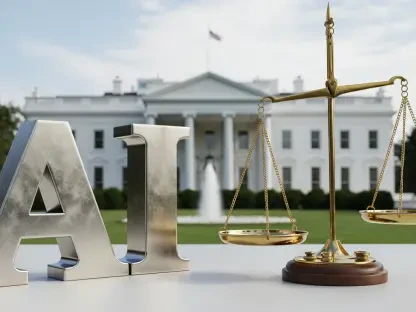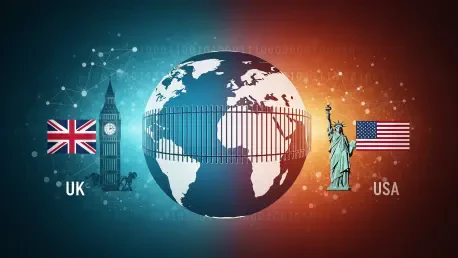

Digital borders are currently being redrawn by legislators in London who believe that a British law should dictate how an American server operates in Virginia or California. This ambitious expansion of regulatory reach has sparked a significant confrontation between the United Kingdom’s Office of Communications, known as Ofcom, and a diverse array of U.S.-based digital platforms. As the global tech industry matures, the friction between national sovereignty and the borderless nature of the internet has moved from theoretical debate to high-stakes legal warfare. Today, the sector is defined by a clash of fundamental philosophies: the European preference for proactive safety mandates versus the American commitment to the First Amendment.
The Global Tug-of-War Over Digital Sovereignty and Free Expression
The digital landscape is no longer the Wild West it once was, as governments worldwide attempt to domesticate the internet through localized statutes. Major market players now find themselves caught in a regulatory crossfire where compliance in one jurisdiction constitutes a violation of cultural or legal norms in another. This environment is heavily influenced by the rise of sophisticated content moderation tools and automated age-verification technologies, which are being pushed as standard requirements for any entity with a global user base.
At the heart of this struggle is the question of who truly owns the digital commons. Regulatory bodies are increasingly treating the internet as a series of distinct national silos rather than a unified global network. This shift has forced technology companies to choose between fragmenting their services to meet local laws or maintaining a singular, global standard of operation that risks heavy fines and blocks. The significance of this conflict cannot be overstated, as it determines whether the future of the internet will be defined by universal access or by a “splinternet” of geographically restricted zones.
Jurisdictional Borders in a Borderless Digital Economy
Trends Reshaping International Content Oversight
A primary trend currently disrupting the industry is the aggressive use of extraterritorial enforcement. Regulators are no longer content with simply blocking offensive content within their own borders; they now seek to penalize the publishers of that content, regardless of where those publishers are physically located. This evolution is driven by the perceived inadequacy of traditional ISP-level blocking, which users can easily bypass via virtual private networks. Consequently, authorities have pivoted toward targeting the financial foundations of platforms through massive administrative fines.
Furthermore, emerging technologies like artificial intelligence are being weaponized on both sides of the aisle. While regulators demand AI-driven “risk assessments” to identify harmful content, platforms are using generative AI to mock these very mandates. This creates a cycle of technological escalation where the speed of innovation often outpaces the ability of lawmakers to draft coherent or enforceable rules. Consumer behavior is also shifting, as users increasingly seek out platforms that resist government interference, viewing such resistance as a hallmark of privacy and authenticity.
Economic Implications and Global Market Projections
The economic stakes of this jurisdictional battle are projected to reach billions of dollars in potential fines and lost revenue over the next few years. Market data suggests that the cost of compliance for mid-sized platforms could rise by as much as thirty percent if they are forced to implement unique safety protocols for every country in which they have users. Growth projections for the digital services sector remain strong, but they are increasingly bifurcated between platforms that can afford massive legal departments and smaller innovators that may be priced out of the international market.
Performance indicators currently show a growing “compliance fatigue” among venture capitalists, who are becoming wary of investing in platforms that lack a clear strategy for navigating international legal minefields. Forward-looking forecasts suggest that if the U.K. successfully collects fines from non-resident companies, other nations will likely follow suit, leading to a global cascade of litigation. This could result in a market where only the largest conglomerates survive, as they are the only entities capable of absorbing the overhead of global speech policing.
The Extraterritorial Reach of the UK Online Safety Act
The U.K. Online Safety Act represents the most significant challenge to the traditional understanding of international law. By demanding that foreign companies submit to age verification audits and risk assessments, British regulators are attempting to export their social values to the rest of the world. The primary obstacle for the U.K. is the lack of physical leverage; if a company has no staff, no offices, and no bank accounts within British territory, the ability to collect a fine remains largely theoretical.
Strategies to overcome this jurisdictional gap often involve the U.K. attempting to pressure international payment processors or advertising networks to blackball non-compliant platforms. However, this tactic risks backfiring by encouraging the development of alternative, decentralized financial systems that operate outside the reach of traditional Western regulators. The complexity of these enforcement actions suggests that while the law is broad on paper, its practical application is limited to companies that maintain a tangible presence in the British market.
The First Amendment vs. Foreign Mandates: A Legal Stalemate
In the United States, the regulatory landscape is anchored by the First Amendment, which provides a robust shield against government-compelled speech and censorship. American courts have historically been hostile to the idea that a foreign power can dictate the editorial policies of a domestic publisher. This creates a legal stalemate where a platform can be perfectly compliant with U.S. law while being deemed a “criminal” enterprise under British safety standards. The role of Section 230 also remains a critical component, providing the legal immunity necessary for platforms to host third-party content without fear of constant litigation.
Moreover, the tension is exacerbated by the U.S. judicial system’s refusal to enforce foreign judgments that are “repugnant” to American public policy. Since the U.K.’s content restrictions often involve the suppression of speech that would be protected in the U.S., any attempt to collect a British fine in an American court would likely be met with dismissal. This legal barrier ensures that for the foreseeable future, the U.S. remains a safe harbor for digital expression that falls outside the increasingly narrow boundaries of European “safety” laws.
From Resistance to Reciprocity: The Future of Global Speech Policing
The industry is currently heading toward a more proactive defense against foreign regulatory overreach. Legal experts are now moving beyond mere non-compliance and are drafting legislative frameworks that would allow U.S. companies to countersue foreign governments for harassment. This “reciprocity” model seeks to turn the tables on global speech policing by making it financially and diplomatically costly for a foreign nation to target American digital infrastructure. Innovation in this area is focusing on tools that allow for granular, geography-based content filtering that satisfies local laws without altering the platform’s global architecture.
Future growth areas will likely involve the expansion of the “creator economy” onto platforms that prioritize jurisdictional independence. As established social media giants succumb to regulatory pressure, a new tier of providers is emerging, built on decentralized protocols that are inherently resistant to national mandates. These disruptors are leveraging consumer preferences for uncensored environments, signaling a shift in market dominance away from centralized entities that are easy targets for government regulators.
Balancing Online Safety with Jurisdictional Independence
The findings of this report indicated that the attempt by the U.K. to regulate American online speech was met with a combination of legal immunity and cultural defiance. The clash between the Online Safety Act and the First Amendment demonstrated that national laws are still largely confined by physical borders, despite the global nature of the internet. It was clear that without a physical presence in the regulating country, platforms were able to successfully ignore foreign mandates, effectively rendering extraterritorial fines as symbolic gestures rather than enforceable penalties.
Moving forward, stakeholders must recognize that the most effective solution for international content disputes lies in technical blocking by the host nation rather than the punishment of foreign publishers. Investment should be directed toward developing localized “walled gardens” for countries that desire them, allowing those nations to protect their citizens without infringing upon the digital sovereignty of others. The industry proved that it could withstand the initial shock of global speech policing, but the long-term stability of the digital economy required a renewed commitment to jurisdictional boundaries and a rejection of the idea that one nation’s safety standards should become the world’s default.