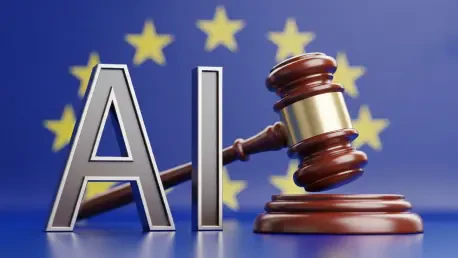

Imagine a world where artificial intelligence shapes every facet of life—from healthcare diagnostics to automotive safety—yet operates under a robust framework ensuring safety and trust. This vision is at the heart of the European Union’s ambitious AI Act, a pioneering piece of legislation designed to govern AI systems across the region. As the tech landscape evolves rapidly in 2025, this review dives into the intricacies of the EU AI Act, exploring its core features, current implementation status, and the profound impact it promises to have on industries and society. With compliance deadlines looming and regulatory challenges emerging, understanding this framework is crucial for stakeholders navigating the future of AI.
Core Features of the EU AI Act
The EU AI Act stands as a landmark regulation, aiming to create a balanced environment where AI innovation thrives alongside accountability. At its core, the Act categorizes AI systems based on risk levels, with stringent rules for those deemed high-risk, such as systems used in critical infrastructure or law enforcement. These provisions focus on ensuring safety, transparency, and ethical usage, setting a global precedent for AI governance. Beyond merely controlling risks, the legislation seeks to foster trust among users by holding developers and deployers to high standards of responsibility.
Delving deeper, the Act mandates comprehensive requirements for high-risk AI systems, including robust risk management protocols, high-quality datasets to prevent bias, and continuous human oversight to mitigate errors. Additionally, it emphasizes cybersecurity resilience to protect against malicious attacks and demands detailed technical documentation for transparency. These features collectively aim to safeguard public interest while allowing room for technological advancement, positioning the EU as a leader in ethical AI deployment.
What sets this regulation apart is its forward-thinking approach to transparency, particularly with AI-generated content like deepfakes or synthetic media. By enforcing labeling obligations, the Act ensures that users can distinguish between human and machine-created outputs, a critical step in combating misinformation. This focus on clarity not only protects democratic processes but also pushes the industry toward innovative solutions like watermarking, blending regulation with creativity to address modern challenges.
Implementation Progress and Performance
As of 2025, the rollout of the EU AI Act is at a pivotal stage, with compliance deadlines approaching within the next couple of years. However, the journey has not been without hurdles. Delays in the development of harmonized standards by European standardization bodies have created uncertainty, leaving companies scrambling to interpret broad, principle-based requirements. The European Commission has responded with initiatives like the Digital Omnibus proposal, which seeks to adjust timelines and provide clarity, potentially extending deadlines to 2027 or beyond if standards remain incomplete.
Despite these delays, there are signs of progress in how industries are adapting to the Act’s demands. Many organizations, particularly in pharmaceuticals and automotive sectors, are proactively aligning their AI systems with interim generic standards to prepare for compliance. This adaptive approach showcases the Act’s influence in driving early action, even as regulatory ambiguities persist. Moreover, discussions around industry-driven Codes of Practice highlight a collaborative effort to bridge gaps, offering practical guidance where official standards lag.
On the transparency front, the performance of the Act’s labeling mandates is under scrutiny as companies experiment with watermarking techniques for AI-generated content. While some solutions show promise in enhancing public awareness, challenges remain in ensuring these measures are foolproof against tampering. The evolving landscape suggests that while the Act’s framework is robust in intent, its real-world efficacy depends on continuous refinement and industry cooperation to tackle emerging threats like misinformation.
Industry Impact and Real-World Applications
The influence of the EU AI Act is already reshaping how AI is deployed across various sectors, demonstrating its practical relevance. In pharmaceuticals, for instance, companies are redesigning AI-driven drug discovery processes to meet stringent risk management requirements, ensuring that patient safety remains paramount. Similarly, the automotive industry is adjusting autonomous driving systems to incorporate mandated human oversight, balancing innovation with accountability in a high-stakes field.
Beyond these sectors, cybersecurity is witnessing a dual effect from the Act’s implementation. On one hand, the legislation pushes for fortified defenses in AI systems to prevent attacks like data poisoning; on the other, it accelerates the adoption of AI tools for threat detection and response. This symbiotic relationship underscores how the Act not only governs but also catalyzes advancements in critical areas, reshaping operational norms for tech-driven industries.
Perhaps most intriguingly, the integration of AI agents into organizational workflows is gaining traction under the Act’s guidelines. Businesses are beginning to embed these autonomous systems into everyday processes, streamlining operations while adhering to compliance standards. This trend points to a future where AI becomes a seamless partner in efficiency, provided that interoperability and governance frameworks continue to evolve in tandem with technological progress.
Challenges and Limitations
Even with its ambitious scope, the EU AI Act faces significant obstacles that temper its early performance. Regulatory ambiguity remains a core challenge, as delayed harmonized standards leave companies navigating a complex web of vague mandates. This uncertainty risks stifling innovation, particularly for smaller firms lacking the resources to interpret and implement broad requirements without clear guidance, creating an uneven playing field in the tech ecosystem.
Another pressing concern lies in balancing data usage with privacy protections. While amendments under proposals like the Digital Omnibus aim to ease restrictions on personal data processing for AI development, they have sparked debates among privacy advocates worried about eroding established safeguards. This tension highlights a broader struggle within the Act’s framework: ensuring that flexibility for innovation does not compromise fundamental rights or public trust.
Additionally, the practical enforcement of transparency rules poses a persistent limitation. Despite efforts to mandate labeling for AI-generated content, the rapid evolution of tools to bypass watermarks and other identifiers undermines effectiveness. This cat-and-mouse game between regulation and technology suggests that while the Act sets a strong foundation, its success hinges on adaptive strategies to stay ahead of cunning adversaries exploiting AI’s capabilities.
Final Thoughts and Future Steps
Looking back on this evaluation, the journey of the EU AI Act revealed a groundbreaking yet challenging endeavor to regulate a transformative technology. Its robust features aimed to ensure safety and transparency, while early implementation efforts showcased both promise and pitfalls across industries. The hurdles of regulatory delays and privacy debates underscored the complexity of governing AI in a fast-paced world.
Moving forward, stakeholders must prioritize collaborative solutions to address these gaps. Industry leaders should continue developing interim Codes of Practice to guide compliance, while policymakers need to expedite the finalization of harmonized standards to eliminate ambiguity. Investing in advanced watermarking technologies and cybersecurity measures will be crucial to uphold transparency and protect against emerging threats.
Beyond immediate actions, a broader dialogue on global AI governance is essential. The EU AI Act can serve as a blueprint, but its true potential lies in inspiring harmonized frameworks worldwide. By fostering international cooperation and sharing best practices, the tech community can build a future where AI drives progress without sacrificing trust or safety, ensuring that innovation remains a force for good.