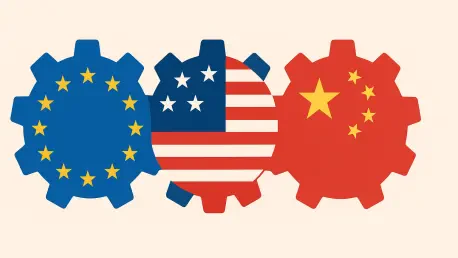

The rapid evolution of artificial intelligence systems has forced a global reckoning over the potential for devastating cyberattacks and threats to national security. In 2026, the proliferation of autonomous agents has transitioned from a technical novelty to a core component of geopolitical strategy, leaving no nation untouched by the secondary effects of rapid algorithmic deployment. As these systems become more deeply woven into the fabric of daily life, the international community has reached a somber consensus on the inherent risks. We see a world where psychological harms to children and the erosion of digital trust are no longer theoretical concerns but daily realities that demand immediate intervention. Consequently, the three primary AI superpowers—the European Union, the United States, and China—have each forged distinct paths. Their diverging philosophies represent a significant fragmentation of the digital world, where the definition of safety is often dictated by local political values rather than a shared global understanding.
The European Union’s Legislative Framework
The European Union transitioned to a guardian of digital ethics with the full implementation of the 2024 AI Act. This framework introduced a rigorous four-tier risk classification system designed to protect fundamental rights from algorithmic overreach. Applications deemed an “unacceptable risk,” such as social scoring or manipulative cognitive behavioral systems, were strictly banned to prevent societal erosion. Meanwhile, high-risk systems in critical sectors like healthcare and law enforcement became subject to intense pre-market scrutiny and transparency requirements to ensure safety.
Despite this stance, the EU struggled with global innovation competition, leading to a complex internal debate over regulatory friction. To address concerns that Brussels was stifling its own tech sector, the European Parliament introduced an Omnibus bill that streamlined compliance pathways for smaller enterprises. Furthermore, the newly proposed EU Kids Act signaled a commitment to social welfare by prohibiting AI-driven emotional companions that foster dependency in minors. This approach prioritizes a human-centric model of progress, even when it risks slower growth compared to other powers.
The United States’ Market-Driven Strategy
The United States has maintained a market-driven strategy focused on preserving its technological edge. The federal posture relies on a “hands-off” philosophy that prioritizes rapid iteration and private investment over centralized mandates. A pivotal shift occurred recently with the revocation of requirements for developers to share safety test results with government agencies. Instead, the 2025 AI Action Plan emphasizes massive infrastructure development and deregulation, viewing the technology as a vital engine that contributes significantly to the national gross domestic product.
This model is further defined by a push for ideological neutrality. The “Preventing Woke AI” order mandates that federal agencies utilize models that avoid specific biases, though the metrics for such neutrality remain a subject of debate. While Congress has yet to pass comprehensive legislation, states like California have implemented their own transparency requirements. On a national level, the White House accord remains the primary guardrail, favoring voluntary audits to ensure that innovation remains unhindered. This reliance on corporate responsibility aims to keep the path to super-intelligence open.
China’s State-Centric Oversight
China’s approach is defined by an uncompromising blend of state-centric control and industrial pursuit. President Xi Jinping has mandated that all high-level systems must remain under human authority, which the state interprets as direct oversight by the government to ensure social stability. Recent regulations have targeted the rise of digital clones and AI companions, strictly banning the creation of virtual replicas of individuals without their explicit consent. This strategy aims to prevent the erosion of social harmony while leveraging the technology to bolster internal security apparatus and surveillance capabilities.
Crucially, China has rejected any calls for a global moratorium on AI development, viewing such proposals as strategic maneuvers by Western nations to hinder its progress. For Chinese policymakers, innovation is a mandatory component of national power. The Ministry of State Security has intensified its focus on AI-generated content, treating generative outputs with the same level of censorship as traditional media to prevent political rumors. By integrating regulation into its security framework, China ensures that the technology serves the collective interests of the state above all else.
Comparison: Global Enforcement and Philosophies
The divergence among these three superpowers illustrates a world divided more by political philosophy than by technical capability. Enforcement mechanisms vary significantly, with the European Union utilizing binding laws while the United States relies on voluntary agreements and deregulation. China, meanwhile, employs direct state intervention and pervasive censorship to manage the risks of the digital age. These methods reflect how each region values the individual; the EU sees a citizen to be protected, the US sees a consumer in a competitive market, and China sees a component of a stable collective that must be steered by the state.
This fragmentation has created a complex landscape for global corporations attempting to navigate conflicting rules. While common ground exists regarding the protection of minors and the mitigation of cyber threats, the lack of a unified enforcement mechanism has led to the balkanization of AI. As these systems move toward greater autonomy, the friction between these models will likely increase, complicating efforts to establish a global safety standard. The result is a digital environment where the same technology is governed by radically different ethics based on geographical context.
Future Outlook: Strategic Recommendations for Industry
The three superpowers established different frameworks that reshaped the digital landscape. While the EU prioritized citizen rights through a legal fortress, the US leaned into an economic engine fueled by deregulation. China constructed a digital panopticon that integrated progress into the state security apparatus. These models reflected values that were difficult to reconcile, leading to a fragmented ecosystem where innovation was siloed by regulatory borders. Each region addressed its primary fears during this formative era, yet the global lack of coordination created unique challenges for the industry.
Moving forward, organizations must prioritize interoperable compliance tools that adjust to local laws. Stakeholders should advocate for a consensus on high-consequence risks, such as the control of critical infrastructure, while allowing for regional diversity in governance. Transparency in the underlying architecture will be essential for fostering cross-border trust. The focus must now shift toward establishing a resilient framework for peaceful coexistence between these competing digital ideologies, ensuring that technological progress remains beneficial for humanity regardless of jurisdictional boundaries.