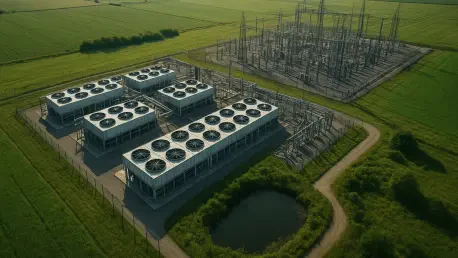

As a legal authority with deep expertise in trade agreements and global compliance, Desiree Sainthrope has spent years navigating the complex intersection of international law and technological expansion. Her work often places her at the heart of debates regarding how massive infrastructure projects—specifically those driving the artificial intelligence boom—interact with sovereign energy grids and environmental regulations. Today, she provides a critical lens on the unfolding situation in Kronstorf, Austria, where a hyperscale data center project has become a lightning rod for concerns over energy security, environmental justice, and the influence of American tech giants on European soil.
In this conversation, we explore the legal and ethical friction between the European Union’s ambitions for AI sovereignty and the tangible limits of local resources. We examine the regulatory loopholes that allow massive data hubs to bypass environmental scrutiny, the potential for rising electricity costs in renewable-heavy markets, and the broader implications of inviting foreign corporations to occupy prime infrastructure sites while domestic players are left on the sidelines.
How do you evaluate the tension between the European Union’s strategic push for technological sovereignty and the localized resistance emerging against massive energy consumers like the facility in Kronstorf?
The tension we are seeing in 2026 is the result of a fundamental misalignment between high-level continental policy and local resource management. While the European Union has set an ambitious target to triple its data center capacity by 2035, national governments are struggling to reconcile these goals with the physical realities of their power grids. In Austria, the fact that a single site could eventually devour 7 percent of the entire country’s power demand creates a significant political and legal headache. We are seeing a clash where the rhetoric of “AI sovereignty” is being used by officials to bypass the very sustainability hurdles they traditionally champion. It is a paradox to claim we are building a sovereign European infrastructure when the primary beneficiaries and operators are American giants, leaving local communities to bear the brunt of the “extreme thirst” for energy and water that these facilities require to operate around the clock.
From a legal and compliance perspective, what are the implications of data centers being exempt from the rigorous environmental impact assessments that other energy projects must undergo?
This is one of the most glaring regulatory discrepancies in the current landscape, and it is a point of major contention for activists and legal experts alike. In Austria, the law currently requires a comprehensive environmental impact assessment for building a single wind turbine, yet a hyperscale data center—which can consume more electricity than 2 million people in a city like Vienna—can sometimes bypass these same requirements. This creates a lopsided legal environment where renewable energy projects are slowed down by red tape while energy-intensive “digital factories” are fast-tracked. The center-left Social Democrats and the Greens are rightly pushing for a revamp of these laws to ensure that projects of this scale are held to the same standards regarding land conversion and water usage. Without a change in the law, we are essentially allowing a “power grab” by tech firms that avoids the transparent scrutiny necessary to protect local ecosystems, such as the thermal health of the River Enns.
The projected energy consumption for this site is staggering, potentially reaching 4.4 terawatt-hours upon expansion. How does such a concentrated demand impact a national grid that is already grappling with climate-induced fluctuations?
When you introduce a 500-megawatt demand into a grid, the ripple effects are felt by every consumer, from private households to small businesses. Austria currently runs on nearly 90 percent renewable power, largely driven by hydropower, but this reliance makes the system incredibly vulnerable to the droughts we are seeing with increased frequency. This past summer, we saw hydropower production fall by as much as a third due to dry conditions, creating a dangerous scenario where supply is shrinking just as a massive new consumer plugs in. Legal and energy experts at the Austrian Energy Agency have already warned that when demand rises and supply cannot keep up, electricity prices will naturally climb, a trend already observed in markets like Ireland where data centers consume a fifth of all electricity. There is a very real risk that the push for “Googlhupf” politics—celebrating these projects for their symbolic value—will lead to a future where the local population pays a premium for the energy used by a foreign entity.
Critics often label corporate environmental initiatives as greenwashing; how do you perceive the effectiveness of measures like solar-paneled roofs and biodiversity funds in mitigating the footprint of such massive infrastructure?
While Google has committed to operating on clean electricity by 2030 and has implemented “compensatory” measures like the “Google forest” and a small “Google biotope” pond, these efforts often feel like a drop in the bucket compared to the actual environmental cost. For instance, the company plans to cover the facility’s roof in solar panels, but these panels cannot possibly offset a 150-megawatt to 500-megawatt hourly demand; the scale of the consumption simply dwarfs the onsite generation. Furthermore, the installation of massive diesel-powered generators as a backup for blackouts contradicts the “carbon-free” narrative, as these machines must be run regularly for testing. From a compliance standpoint, these biodiversity funds and “biotopes” function more as public relations tools than as substantive environmental safeguards. When you consider that a “safe haven” for wildlife at the entrance of a massive construction site is being compared to an “oversized puddle,” it highlights the sensory and emotional gap between corporate promises and the physical reality on the ground.
There is a growing sentiment that domestic companies are being sidelined in favor of American giants for prime infrastructure locations. What are the long-term risks of allowing foreign entities to dominate the most efficient energy hubs?
The decision to grant the best spots—areas with flat plains, easy river access for cooling, and proximity to major power substations—to foreign firms is a significant strategic risk that local activists are now highlighting. By letting American companies take the “best spots” in places like Kronstorf, European nations may be forced to build expensive new power lines to less desirable locations for their own future domestic projects. While the government argues that these investments bring high-performance cloud and AI infrastructure, the actual local economic benefit is often limited to a relatively small number of jobs—only about 100 in this particular case. The long-term concern is that the revenues and intellectual property generated by this infrastructure are exported back to the United States, while the physical and environmental costs are permanently socialized within the host country. This creates a form of digital colonialism where the host nation provides the raw resources—land, water, and energy—but has little say in how the resulting value is distributed.
What is your forecast for the future of European data infrastructure?
My forecast for the period between 2026 and 2030 is one of significant regulatory tightening and increased litigation. We are moving away from the “honeymoon phase” where governments welcomed tech giants with open arms and bundt cakes, and into a phase of rigorous accountability. I expect to see mandatory requirements for data center operators to not just “use” clean energy, but to actively fund and build out additional renewable generation to compensate for their massive draws on the grid. We will likely see a harmonization of environmental laws across the EU that closes the gap between energy production and data consumption, ensuring that a server hall is treated with the same environmental gravity as a chemical plant or a coal mine. The “blanket rejection” that some ministries fear will become a standard tool for communities until tech giants can prove that their presence won’t lead to higher utility bills or dry rivers for the people living next door.