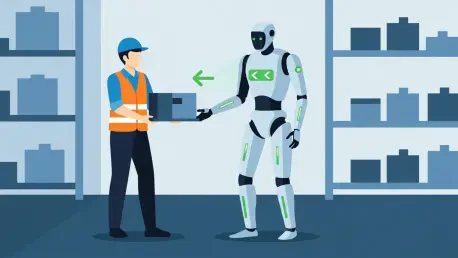

The most advanced humanoid robots standing ready to revolutionize industry are paradoxically held captive not by technical limitations but by safety regulations designed for their stationary ancestors. Humanoid robots represent a significant advancement in the industrial and service sectors. This review will explore the evolution of their safety requirements, key technological features designed to mitigate risk, performance metrics in dynamic environments, and the impact that current regulatory frameworks have on their application. The purpose of this review is to provide a thorough understanding of the technology’s safety challenges, its current capabilities, and its potential future development as regulations evolve to meet kinetic reality.
The Rise of Humanoids and the Legacy Safety Crisis
Humanoid robots, defined by their dynamic bipedal motion and sophisticated systems for stability and interaction, have emerged as a disruptive force in automation. Unlike their predecessors—caged, bolted-down robotic arms performing repetitive tasks—humanoids offer unparalleled mobility and autonomy, capable of navigating complex, human-centric environments. Their ability to adapt to factory floors, warehouses, and logistics centers without requiring extensive infrastructure redesign positions them as a transformative technology. This mobility, however, exposes a fundamental crisis in legacy safety protocols, which were never designed to account for a machine that can walk, stumble, and fall.
The core of this crisis stems from a mismatch between the robot’s dynamic nature and the static assumptions underpinning industrial safety. Traditional standards focus on predictable workspaces and controllable failure states, such as a robotic arm ceasing movement. A humanoid robot, in contrast, introduces the concept of dynamic instability as its primary risk factor. A simple malfunction is no longer just a system halt; it can become a kinetic event, transforming a 60-kilogram machine into an unguided projectile. This reality renders existing safety certifications and risk assessments obsolete, creating a juridical grey zone that stalls widespread deployment and leaves adopters facing immense liability.
Critical Safety Technologies and System Design
Re-engineering Emergency Protocols: From Power-Cut to Software Decoupling
The classic “big red button” emergency stop, a cornerstone of industrial safety, is dangerously counterintuitive when applied to humanoid robots. For a traditional machine, cutting power ensures a safe halt. For a bipedal robot, this same action disables the very motors and algorithms responsible for maintaining balance, instantly inducing an uncontrolled collapse. This reaction is often more hazardous than the initial problem the emergency stop was intended to solve, creating a scenario where the safety protocol itself becomes the primary threat to nearby human workers.
To address this critical flaw, a paradigm shift toward software decoupling is underway. This advanced safety logic separates a robot’s task-oriented functions (e.g., lifting a crate) from its core stability algorithms. When an emergency stop is activated, the system terminates the active task but preserves power to the balance-control systems. This allows the robot to remain standing safely or, if necessary, initiate a controlled descent. By prioritizing stability above all else, software decoupling transforms the emergency stop from a trigger for catastrophic failure into an intelligent and predictable safety measure, forming a foundational element for safe human-robot collaboration.
Advanced Fall Mitigation and Controlled Descent Strategies
Recognizing that falls are an inevitable, if rare, possibility, the industry has shifted focus from preventing all falls to managing them with precision. The primary goal is to minimize the transfer of kinetic energy to the environment and any humans within it. Advanced humanoid platforms are now equipped with controlled descent protocols, such as programmed kneeling mechanisms that rapidly lower the robot’s center of gravity. This simple maneuver drastically reduces the potential impact force, turning a chaotic collapse into a managed event.
Further enhancing these systems are biomimetic safety features inspired by natural shock absorption. Designs incorporating external crumple zones or even deployable airbags are engineered to absorb and dissipate impact energy, much like the safety features in a modern automobile. Critically, these systems also focus on making fall trajectories predictable. By programming the robot to fall in a specific, predetermined direction, human operators can be trained to anticipate its movement, clearing the area and transforming a random accident into a calculated, manageable safety procedure.
Redundant Sensing and Operator Sovereignty
A humanoid robot’s ability to operate safely is entirely dependent on its perception of the world. In the cluttered and unpredictable environments of a factory or warehouse, a single sensor modality is a point of failure. Consequently, the standard for safe operation is an aggressive fusion of multiple sensor types, including LiDAR for distance mapping, thermal cameras for detecting humans, and ultrasonic arrays for close-proximity awareness. This multi-sensor approach creates a high-fidelity, 360-degree environmental model that is resilient to failure; if a camera is blinded by glare, LiDAR and thermal sensors compensate, preventing a kinetic failure caused by a perception error.
Ultimately, however, no algorithm can replace human judgment in a crisis. The principle of operator sovereignty remains a non-negotiable tenet of humanoid robot safety. This principle is enforced through hard-wired, physical kill switches that provide a human operator with the ultimate authority to override any autonomous action. This manual override bypasses software logic entirely, ensuring that a human remains the undisputed master of the machine’s actions. This safeguard is not merely a feature but a foundational requirement, ensuring that accountability and final control rest in human hands, a principle reinforced by standards bodies like the National Institute of Standards and Technology (NIST).
Evolving Standards in Human-Robot Interaction
The human-like form of these robots introduces unique psychological challenges that legacy safety standards do not address. Humans are naturally inclined to project intent and awareness onto entities with a familiar shape, a phenomenon known as anthropomorphic bias. This can lead workers to develop a misplaced sense of trust, causing them to lower their guard or assume the robot has a higher level of situational awareness than it actually possesses. This cognitive dissonance can also create stress and delay reaction times during a malfunction, as the human brain struggles to classify the machine as either a peer or a tool.
To mitigate these risks, new safety standards are emerging that focus on creating a universal language for robot intent. A silent, moving machine is an unpredictable hazard, so humanoids must be designed to continuously and clearly broadcast their status and upcoming actions. This is being achieved through a combination of visual and audio cues, such as directional lights to indicate path intentions, motion-activated sounds to signal movement, and status displays on face screens to convey operational mode. By making the robot’s behavior explicit and readable, its actions become predictable, transforming it from a source of uncertainty into a reliable and safe collaborator for its human colleagues.
Industrial Integration and Deployment Barriers
Humanoid robots are currently being tested for deployment in industries like manufacturing, logistics, and warehousing, where they promise to fill labor gaps and handle physically demanding or repetitive tasks. Their unique ability to operate in spaces designed for humans makes them ideal for retrofitting existing facilities without costly re-engineering. They can perform tasks ranging from picking and sorting packages in a distribution center to assisting in complex assembly lines, offering a degree of flexibility that traditional automation lacks.
Despite these promising applications, widespread implementation is being blocked by a formidable “Regulatory Wall.” This barrier is not technological but legal and procedural. The profound gap between the dynamic nature of humanoids and the static safety standards governing industrial machinery creates a paralyzing liability shield for potential adopters. Companies are hesitant to deploy these billion-dollar platforms when it remains unclear how to certify them as safe, who is liable in the event of an algorithm-driven accident, and how to insure against risks that have no precedent. This regulatory uncertainty is the single greatest barrier preventing the technology from scaling beyond pilot programs.
The Regulatory and Legal Hurdles to Mass Adoption
The core of the legal challenge lies in the inadequacy of existing industrial standards, particularly ISO 10218, which was written for caged robotic arms. This framework contains no provisions for dynamic instability, offers no methodology for assessing the risk of a fall, and fails to address the complexities of autonomous decision-making in an unstructured environment. As a result, humanoid robots exist in a legal vacuum; they do not fit the classification of a vehicle, a tool, or a traditional Autonomous Mobile Robot (AMR), each of which carries different legal and insurance implications.
Efforts are underway to bridge this dangerous gap. The development of new standards, such as ISO 25785-1, is a crucial first step toward creating a regulatory framework that acknowledges the unique characteristics of “unstable robots.” These emerging standards aim to establish a legal baseline by defining metrics for mobility, degrees of freedom, and levels of autonomy. This work is essential for resolving the liability question: when an algorithm makes a decision that leads to an incident, a clear framework is needed to determine responsibility. Without it, the legal and financial risks are simply too high for mass adoption.
The Current Pivot to Functional Safety Classification
The resolution to this regulatory impasse is materializing through a fundamental pivot in safety philosophy—a move toward functional classification. This new paradigm, which is actively shaping the current regulatory landscape, abandons outdated, form-based rules (e.g., classifying a robot by its number of limbs) in favor of physics-based risk assessments. Regulators and standards bodies are now focusing on evaluating a machine’s potential for harm based on its raw kinetic energy, considering its mass, speed, and force-imparting capabilities as the primary metrics for safety.
This shift fosters a move toward result-oriented mandates. Instead of prescribing specific hardware components, new regulations will demand a fail-safe outcome, such as “the system must not cause injury to a human,” leaving companies the freedom to innovate on the best technological solutions to achieve that goal. This approach decouples technical progress from restrictive, outdated component lists and is the only viable path for enabling the transition of humanoids from controlled factories to unpredictable public spaces, where safety requirements will be exponentially stricter.
Conclusion: Aligning Compliance with Kinetic Reality
The journey of humanoid robots into the industrial mainstream was defined by a critical mismatch between their dynamic capabilities and the static safety regulations that governed their environment. The primary obstacle was not a failure of engineering but a “Regulatory Wall” built on outdated standards that could not account for kinetic risk or dynamic instability. Overcoming this barrier required a comprehensive reimagining of safety protocols, from re-engineering the emergency stop to implementing intelligent fall mitigation systems.
Ultimately, the technology’s future hinged on a philosophical shift in regulatory thinking. The move toward functional, outcome-based safety standards, which prioritize the physical reality of kinetic energy over arbitrary hardware classifications, proved to be the pivotal development. This alignment of compliance with kinetic reality finally provided the legal clarity and liability framework necessary to unlock the immense potential of humanoid robots, paving the way for their secure and scalable integration into industry and society.