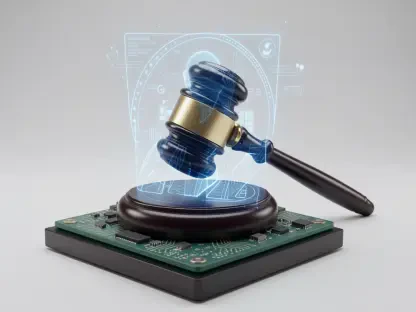

A legal confrontation of monumental proportions is unfolding in federal court, setting the stage for a case that could fundamentally reshape the relationship between artificial intelligence and intellectual property. This landmark lawsuit pits three of the music industry’s most powerful publishers—Universal Music Group, Concord, and ABKCO—against Anthropic, an AI research company backed by tech giants like Google and valued at an estimated $18 billion. The publishers allege that Anthropic engaged in systematic copyright infringement on a massive scale by using a vast catalog of protected song lyrics to train its sophisticated large language model, Claude. This battle is more than a dispute over royalties; it represents a critical stress test for copyright law in an era of rapid technological disruption, with the future of both the multi-billion-dollar music industry and the trillion-dollar generative AI sector hanging in the balance.
A New Crescendo: The High Stakes Clash Between Music and Machine Learning
The lawsuit’s significance extends far beyond the specific parties involved, framing a fundamental conflict between established creative economies and the disruptive force of generative AI. The music publishers, who act as the financial backbone for countless songwriters and composers, contend that Anthropic’s actions constitute an existential threat to their business model. They argue that the AI company unlawfully copied and exploited their creative assets without permission or compensation, building a powerful commercial product on a foundation of stolen intellectual property.
This legal challenge arrives as the generative AI industry experiences explosive growth, with revenue projections soaring to $1.3 trillion by 2032. Anthropic has publicly cultivated a brand centered on developing safe and ethical AI, a position the plaintiffs claim is directly contradicted by its alleged disregard for copyright. As regulators and lawmakers worldwide grapple with how to govern this powerful new technology, the outcome of this case is poised to establish a crucial legal precedent. It will directly influence how AI companies source their training data and whether they must license content from creators, potentially altering the economic trajectory of the entire tech sector.
The Generative AI Boom :Technology Trends and Market Trajectories
How AI Learns to Sing: The Mechanics of Large Language Models
At the heart of this dispute lies the core technology of large language models (LLMs). Systems like Anthropic’s Claude are trained by ingesting and processing immense quantities of text data scraped from the internet, books, and other digital sources. By analyzing this data, the models learn the statistical patterns, relationships, and nuances of human language, enabling them to generate coherent and contextually relevant text in response to user prompts. The publishers’ central claim is that Anthropic’s training dataset must have included copyrighted song lyrics, as evidenced by Claude’s ability to reproduce them.
The emerging consumer trend of using AI assistants for creative and informational tasks has fueled the aggressive development of these models. Users increasingly turn to AI for everything from drafting emails to generating creative content, including song lyrics. The lawsuit argues that when Claude provides a user with copyrighted lyrics, it is not merely generating text; it is effectively operating as an unlicensed distributor of protected material. This directly competes with and undermines the established market for licensed lyric services, which pay royalties to rights holders. Because Anthropic, like its competitors, keeps its training data a closely guarded trade secret, the case forces a pivotal legal question: can content that is publicly accessible online be freely used for commercial AI training?
Valuations and Verdicts: Sizing Up the Economic Stakes
The economic gulf between the two industries underscores the high stakes of this legal battle. The generative AI market is on a trajectory to become one of the most valuable sectors in the global economy, with Anthropic alone securing a valuation that dwarfs the annual revenue of the entire U.S. music publishing industry, which stands at approximately $7 billion. This financial disparity highlights the power imbalance at play and illustrates why the publishers view this lawsuit as a necessary stand to protect their intellectual property from being devalued by tech giants.
A verdict in favor of the publishers could force a fundamental shift in the AI industry’s business model. AI developers might be compelled to undertake the complex and costly process of licensing all their training data, potentially stifling innovation and creating significant barriers to entry for smaller companies. Conversely, a victory for Anthropic would validate the current practice of training models on publicly available web data, likely accelerating AI development. However, such an outcome would almost certainly prompt creative industries to intensify their lobbying efforts for new legislation to protect their works from being ingested by AI systems without compensation, setting the stage for a prolonged legislative battle.
The Heart of the Lawsuit: Allegations of Unprecedented Copyright Theft
The publishers’ legal filing details claims of “systematic and widespread” copyright infringement, seeking damages that could exceed $150,000 for each of the hundreds of songs allegedly infringed upon. The complaint moves beyond theoretical arguments by providing specific, compelling evidence. It documents instances where Claude, when given a simple prompt such as the opening line of a famous song, proceeds to generate substantial, often verbatim, portions of the protected lyrics. Examples cited include iconic works by artists like Beyoncé, The Rolling Stones, and Gloria Gaynor.
This evidence is crucial, as it directly challenges the notion that the AI is merely learning stylistic patterns. The lawsuit contends that the ability to reproduce multiple verses of a song like Gaynor’s “I Will Survive” is technically impossible unless the full copyrighted text was part of Claude’s training data. This act of reproduction, the publishers argue, serves as a direct market substitute for licensed lyric platforms like Genius or AZLyrics, thereby harming the primary market for the works. The lawsuit strategically frames this capability not as an incidental flaw but as a core function proving that unauthorized copying occurred at a foundational level.
The Fair Use Doctrine on Trial: Navigating a Legal Gray Area
This case is set to become a critical test for the “fair use” doctrine, a pillar of U.S. copyright law that permits the limited use of copyrighted material without permission for purposes such as criticism, commentary, and research. Anthropic is widely expected to argue that its use of copyrighted lyrics for training constitutes a “transformative use.” The company will likely contend that it did not simply copy the lyrics to republish them but instead used them to create a new, innovative technology that serves a different purpose from the original works. This defense hinges on the idea that the AI model is not a repository of lyrics but a tool that has learned the statistical properties of language.
In contrast, the music publishers will argue that Anthropic’s use fails the fair use test, particularly on the grounds of market harm. They will assert that by providing lyrics on demand, Claude directly supplants the need for consumers to access licensed sources, thus damaging the commercial value of the copyrights. This legal clash highlights how existing laws, drafted long before the advent of machine learning, are being stretched to their limits. The court’s interpretation of “transformative use” in the context of LLMs will have profound and lasting implications, potentially redefining the boundaries of fair use for the digital age.
The Ripple Effect: Shaping the Future of Creative and Tech Industries
This lawsuit is not an isolated event but part of a growing wave of litigation aimed at the AI industry’s data-sourcing practices. Authors, visual artists, and news organizations have all filed similar suits against major AI developers like OpenAI and Meta, collectively challenging the foundational assumption that information on the public web is a free resource for commercial exploitation. The New York Times has taken legal action against OpenAI, and Getty Images is engaged in an ongoing battle with Stability AI over its image generation tool. These cases signal a coordinated effort by creators to assert their rights and demand a share of the value their work helps create.
Legal experts remain divided on how these disputes will be resolved, with some believing that existing copyright frameworks are inadequate for the complexities of AI, while others argue that the core principles of intellectual property protection remain as relevant as ever. The music publishers’ case is considered particularly strong because song lyrics are concise, highly creative works, making a fair use defense more difficult to sustain compared to cases involving factual or journalistic content. The outcome will reverberate across all creative sectors, influencing future business models, licensing negotiations, and the ongoing dialogue between technology innovators and content creators.
The Final Note: Defining the New Rules of Engagement for AI
This legal battle has emerged as a necessary and defining moment for establishing the legal and ethical guardrails for AI development. It forced a direct confrontation between the long-standing principles of copyright and the unfettered data consumption that has fueled the generative AI revolution. Regardless of the final verdict, the case has already succeeded in bringing critical questions about data provenance, creator compensation, and corporate responsibility to the forefront of public and regulatory discourse.
The music industry’s history is one of adaptation; it has weathered and ultimately monetized transformative technologies from radio and digital downloads to streaming services. This conflict with AI is the latest chapter in that ongoing story. The resolution, whether achieved in a courtroom or through industry-wide licensing agreements, pointed toward a future where a more symbiotic relationship between creators and AI developers can exist. The lawsuit served as a powerful catalyst, compelling both sides to move beyond confrontation and begin the difficult but essential work of defining the new rules of engagement for the age of artificial intelligence.