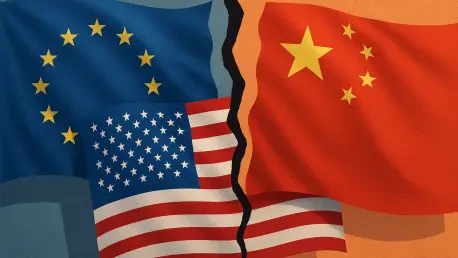

As the global race to define the future of artificial intelligence intensifies, a deep and widening chasm has emerged between the United States and the European Union, creating a strategic opening that Beijing is poised to exploit. This growing divergence in AI governance, rooted in fundamentally different philosophies about innovation, regulation, and societal values, is more than a simple policy disagreement; it represents a fragmentation of the Western approach to technology at a critical juncture. While this discord certainly provides a tactical advantage to China, it is not the primary catalyst for its global ambitions. Beijing is not merely reacting to Western disunity but is instead methodically executing a pre-existing, long-term strategy to establish an alternative model for global AI governance. This proactive campaign is aimed squarely at reshaping the international technological order by building a formidable coalition of support, with its focus centered predominantly on the nations of the Global South.
The Foundational Transatlantic Divide
A Clash of Philosophies
The United States has consistently championed a market-driven approach to artificial intelligence, a philosophy formally articulated in its “AI Action Plan.” This model is characterized by its emphasis on minimal government regulation and the promotion of voluntary frameworks, designed to unleash the full potential of its technology sector. The primary objective is to accelerate financial and technological innovation, ensuring that American companies maintain their global competitive edge without being encumbered by the burdens of stringent compliance requirements. This perspective is deeply intertwined with the prevailing ethos of Silicon Valley, which prioritizes rapid development cycles, market leadership, and the freedom to experiment without preemptive regulatory hurdles. The underlying belief is that innovation flourishes best in an environment of limited government intervention, where market forces are the ultimate arbiters of success and failure. This hands-off approach aims to foster a dynamic ecosystem where new AI applications can be developed and deployed swiftly, solidifying America’s position as the world’s preeminent technological powerhouse.
In stark contrast, the European Union’s landmark “AI Act” embodies a rights-based, precautionary principle that places the protection of fundamental human values at the forefront of its regulatory agenda. This approach favors the implementation of strict, legally binding rules and robust ethical frameworks designed to govern the development and deployment of artificial intelligence systems. The central goal of the EU’s model is the preservation of human rights, the reinforcement of democratic institutions, and the upholding of the rule of law. Unlike the American focus on commercial interests, the European perspective prioritizes societal well-being and individual protections, viewing technology as a tool that must serve humanity, not the other way around. This regulatory paradigm establishes clear red lines for high-risk AI applications and imposes significant transparency and accountability obligations on developers. By creating a comprehensive legal structure, the EU seeks to build public trust in AI and ensure that technological progress aligns with its core democratic principles, even if it means a slower pace of innovation compared to its transatlantic counterpart.
Escalating Tensions
What began as a foundational disagreement over policy has recently intensified, evolving from a philosophical debate into a point of direct and open friction between the two Western powers. A significant escalation occurred when the U.S. president explicitly threatened to impose punitive tariffs on nations, including key European allies, whose technology regulations or digital services taxes were perceived as being specifically “designed to harm or discriminate against American technology.” This direct threat underscores the seriousness of the transatlantic fragmentation, demonstrating that the divide is no longer confined to the realm of regulatory theory but has tangible economic and diplomatic consequences. The move signaled a shift from passive disagreement to active opposition, suggesting a willingness to use economic coercion to protect national commercial interests in the technology sector. Such actions risk undermining the very foundation of the Western alliance, transforming partners into economic adversaries in the critical domain of digital governance.
The implications of this escalating tension extend far beyond the immediate threat of tariffs, risking a broader unraveling of transatlantic cooperation on global technology policy. This internal conflict creates a power vacuum and a crisis of leadership at a time when a unified Western voice is most needed to shape international norms for emerging technologies. The inability to present a common front on issues as critical as AI governance weakens the collective influence of democratic nations in multilateral forums, making it more difficult to advocate for principles like transparency, accountability, and human rights. This disunity not only invites strategic exploitation by geopolitical rivals but also complicates efforts to address shared challenges, such as ensuring AI security, establishing common data protection standards, and countering the use of technology for authoritarian purposes. The friction over AI regulation could easily spill over into other domains, from trade and investment to security and defense, further eroding the cohesion of an alliance that has been a cornerstone of the international order for decades.
China’s Calculated Response
Exploiting Western Disunity
The public and increasingly acrimonious disagreement between the United States and the European Union provides significant strategic advantages for China on the global stage. This transatlantic discord directly reinforces Beijing’s long-held narrative that “the East is rising, and the West is declining,” a message it consistently promotes both domestically and internationally. The perception of a weakening and divided Western alliance bolsters China’s confidence, emboldening it to adopt a more assertive and uncompromising diplomatic stance in its dealings with Western powers, particularly the EU. This newfound confidence translates into increased leverage in geopolitical negotiations. For instance, in response to potential European restrictions on Chinese products in strategic sectors like electric vehicles or semiconductors, Beijing could retaliate not just with traditional economic measures but by leveraging its dominant control over critical raw material supply chains—a far more powerful and asymmetric tool. This dynamic shifts the balance of power, allowing China to negotiate from a position of greater strength.
Furthermore, the absence of a unified Western position on artificial intelligence governance has created a significant leadership vacuum in key international forums. This void presents a critical opportunity for China to execute a strategy often described as “overtaking on a bend”—using a competitor’s moment of distraction and weakness to surge ahead. China has astutely positioned itself as a vocal proponent of multilateralism in the governance of emerging technologies, a stance that contrasts sharply with Washington’s recent skepticism toward the creation of new international regulatory bodies. This was vividly demonstrated during the 2025 UN Global Dialogue on AI, where the United States was one of the few nations to oppose a new multilateral governance institution. In contrast, China emerged as a strong supporter, aligning itself with the majority of nations and cultivating an image as a responsible and collaborative global stakeholder. By championing inclusivity and multilateral solutions while the West is mired in internal disputes, China is actively working to fill the leadership gap and shape the future rules of global technology in its favor.
A Proactive Long-Term Vision
While the transatlantic divide offers clear tactical benefits, it is crucial to understand that China’s strategy is not merely opportunistic or reactive. Beijing’s plans to establish an alternative global AI governance framework are far more systematic and predate the current level of Western fragmentation. The groundwork for this ambitious agenda was laid between 2017 and 2020, when Beijing began formulating its own domestic AI regulations, carefully aligning them with its state-led vision for technological development and social management. This domestic foundation served as a springboard for its international ambitions, which were formally unveiled in 2023 with President Xi’s “Global AI Governance Initiative.” This initiative articulated the key tenets of China’s proposed model, which include a strong emphasis on national sovereignty in AI development, a firm opposition to ideological divisions in technology governance, and a demand for the inclusive and meaningful participation of countries from the Global South. This was a clear declaration of intent to challenge the existing Western-dominated order.
Following the 2023 initiative, Beijing further solidified its vision by releasing an even more comprehensive and ambitious “Global Artificial Intelligence Governance Action Plan” in 2025. This detailed document outlines 13 specific agendas for international AI coordination, spanning a wide range of critical areas such as international standard-setting, digital infrastructure investment, and the establishment of ethical norms. Each proposal is carefully framed within a broader call for an “open, inclusive, and fair” international order for AI, a narrative designed to appeal to nations feeling marginalized by the current system. Crucially, this AI-specific agenda is not a standalone policy but a vital component of China’s much broader ambition to reform global governance as a whole, as articulated in President Xi’s overarching “Global Governance Initiative.” Consequently, whether the EU and the U.S. find common ground or remain divided is, in many respects, a secondary concern for Beijing. Its primary strategic focus on achieving greater influence in global tech governance remains unwavering, consistent, and independent of Western political dynamics.
The Emerging Geopolitical Blocs
A Tripolar World Order
The global landscape of artificial intelligence governance is not shaping up to be a simple binary competition between a singular Western model and a Chinese one. Instead, the world is progressively fragmenting into three distinct and ideologically driven poles, a complex reality that Beijing understands and is strategically navigating. The first is the American pole, characterized by its deep-seated commitment to market-led innovation, corporate autonomy, and minimal government regulation. This model prioritizes speed and commercial success, entrusting the private sector to lead the charge in technological advancement. The second is the European pole, defined by its focus on strict, rights-based regulations, comprehensive ethical oversight, and the staunch protection of democratic values. This approach prioritizes societal well-being and individual freedoms, establishing a legal framework to mitigate the potential harms of powerful AI systems. The third is the Chinese pole, which is centered on state-led innovation, tight government control over data and technology development, and a strong emphasis on national security and state-driven economic development.
For Beijing, the strategic value of the ongoing EU-U.S. divide lies not in the faint hope that either Western power will adopt its state-centric model—as both the American and European approaches are fundamentally committed to liberal-democratic values like transparency and human rights, which are antithetical to China’s system. Rather, the true advantage is in the prevention of a unified and coherent Western bloc. The existence of two distinct and often competing Western approaches prevents the formation of a single, powerful counterweight to China’s vision for global technology governance. This fragmentation effectively elevates the Chinese model from being a fringe alternative to a credible third option on the global stage. It allows China to position its framework as a viable choice for nations that are either skeptical of the American market-first approach or find the European regulatory burden too onerous, thereby expanding its sphere of influence in a divided world.
The Global South as the Key Battleground
China’s most significant and resource-intensive strategic effort is not directed at exploiting Western divisions but at systematically building a broad coalition of like-minded nations, with its primary focus on the Global South. The governance model it promotes is intentionally designed to resonate with the practical needs and political realities of many developing countries. By prioritizing state-led development, asserting firm control over national data sovereignty, and promising tangible economic benefits, China offers a framework that aligns with the developmental goals of governments seeking to leverage technology for rapid economic growth without ceding control to foreign corporations or regulatory bodies. Chinese officials consistently reinforce this message in international forums, arguing that AI governance must accommodate the unique developmental demands of emerging economies and should not be dictated solely by the priorities of wealthy, post-industrial nations. This tailored approach makes its model highly appealing to a large and influential bloc of countries.
Beijing is actively backing its persuasive rhetoric with concrete actions and substantial investments. The 2025 Global AI Action Plan explicitly prioritizes investment in digital infrastructure, promotes technology transfer, and outlines comprehensive capacity-building programs for developing countries. Furthermore, China has proposed an “AI Capacity-Building Action Plan for Good and for All” and is working to establish a “World Artificial Intelligence Cooperation Organization.” These initiatives are strategically designed to share Chinese technology and enhance the AI governance capabilities of other developing nations, effectively locking them into China’s technological ecosystem and standards. The ultimate objective of these multifaceted efforts is to unite the countries of the Global South under Beijing’s vision of “a community with a shared future for mankind.” Chinese strategists have calculated that securing the broad and enduring support of developing nations for its AI governance model is a more durable and effective path to global influence than merely capitalizing on the temporary and shifting conflicts between Brussels and Washington.
A Path Toward Coordinated Action
The ideological chasm separating the state-centric Chinese model from the rights-focused Western approaches made the prospect of a single, universally inclusive global framework for AI nearly impossible. As predicted, the world moved inexorably towards a state of distinct geopolitical and technological blocs. Beijing continued steadfastly on its independent path, methodically leading its own coalition of emerging economies and promoting its vision through multilateral forums where its influence was strongest, such as the United Nations and the Shanghai Cooperation Organization. For Western policymakers, the key takeaway from this period was a clear and urgent call to action. It became apparent that instead of worrying excessively about Beijing exploiting their divisions, the European Union and the United States first had to prioritize resolving their own fundamental differences and establishing common ground.
A coordinated transatlantic strategy was ultimately recognized as the only effective means of counterbalancing China’s growing normative influence on the world stage. This realization prompted the creation of a joint framework for AI security, data protection, and ethical standards, which sought to bridge the gap between their respective market-driven and rights-based approaches. Ultimately, the long-term success of any governance model was determined not by political maneuvering, but by its substantive value and its appeal to the global community. It was this understanding that drove the EU and the U.S. to collaborate on creating high-standard, reliable, and inclusive AI governance plans that could effectively compete with the Chinese alternative and offer a compelling vision for the future of technology.