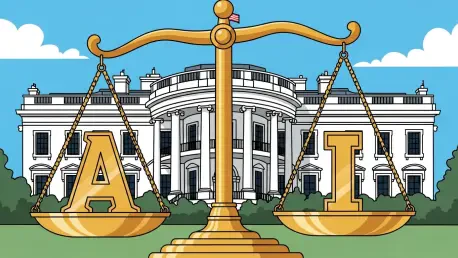

The burgeoning field of artificial intelligence now finds itself at a critical national crossroads where the federal government’s push for global dominance directly confronts a growing and complex web of state-level regulations. A new Executive Order, titled “Ensuring a National Policy Framework for Artificial Intelligence,” signals a dramatic shift in federal strategy, aiming to dismantle the fragmented regulatory landscape that has emerged across the United States. This move is not merely a policy adjustment but a strategic offensive designed to centralize control, foster a uniform environment for innovation, and assert federal supremacy in a domain critical to national economic and security interests. The order sets the stage for a period of intense legal and political conflict, forcing businesses and state governments alike to navigate a landscape suddenly fraught with new uncertainties and challenges.
A Nation Divided: The Clash Between Federal Ambition and State-Level AI Governance
The administration’s assertive stance is deeply rooted in the strategic imperative for the United States to lead the global “AI race.” Policymakers view a coherent, national approach as indispensable for competing with state-backed initiatives from other nations and for setting international norms. A fragmented domestic policy, in this view, not only hinders technological progress but also weakens the nation’s position on the world stage. The goal is to create an environment where American companies can innovate rapidly and scale their technologies without being encumbered by conflicting jurisdictional demands, thereby securing a decisive competitive advantage in the decades to come.
This federal ambition, however, runs directly into the reality of American federalism, where states have become active laboratories for AI governance. In the absence of comprehensive federal legislation, a diverse “patchwork” of state-level regulations has taken root, addressing issues from biometric privacy and algorithmic bias to autonomous vehicle deployment. While these laws often aim to protect consumers and ensure fairness, their variety creates significant operational and compliance headaches for companies that operate nationwide. A developer in California may face entirely different disclosure requirements and liability standards than one in Texas or New York, stifling the seamless deployment of AI services across state lines.
The White House’s core objective is to replace this complicated tapestry with a unified and “minimally burdensome” national policy framework. The intent is to foster consistency, reduce compliance costs, and provide the regulatory predictability that the AI industry argues is essential for long-term investment and growth. This initiative creates a clear battleground with distinct actors. On one side is the Executive Branch, wielding federal agencies as its instruments. On the other are state legislatures and attorneys general, protective of their authority to regulate commerce and protect their citizens. Caught in the middle is the AI industry, which, while generally favoring a single federal standard, must now contend with the turbulence created by this federal-state power struggle.
Analyzing the Executive Order’s Strategic Thrust
The Primary Drivers Behind the Push for Federal Preemption
The administration’s push for federal preemption is fueled by three primary concerns that officials believe threaten the national AI ecosystem. First and foremost is the escalating compliance burden imposed by disparate state laws. For AI developers and deployers, navigating dozens of unique regulatory regimes is not just costly but can be practically impossible, forcing them to either adopt the strictest standard nationwide or develop costly jurisdiction-specific models. Second, there is a pronounced concern that certain state regulations may compel developers to embed “ideological bias” within their AI models, particularly through rules designed to achieve specific social or demographic outcomes. The administration argues this could force models to alter “truthful outputs” in the name of fairness, a practice it deems problematic.
A third major driver is the potential for state rules to impede the free flow of interstate commerce, a core principle of the U.S. economy. When a state’s AI law effectively dictates how a national service must operate, it can create an undue burden on businesses located elsewhere, potentially violating constitutional principles. This concern has been amplified by the proactive stance of states like Colorado, which have enacted specific laws targeting AI-driven bias and discrimination in areas like employment and insurance. These pioneering state-level efforts, while intended to protect consumers, have served as a catalyst, prompting a federal response aimed at preventing such models from proliferating nationwide and creating further fragmentation.
Ultimately, this federal initiative is also a response to a market-driven desire for stability. The AI industry, from startups to established tech giants, has consistently called for a clear and uniform regulatory environment. The uncertainty created by the current patchwork of state laws chills investment and slows the deployment of new technologies. A predictable federal framework, even one with its own compliance demands, is often seen as preferable to a chaotic system of conflicting and ever-changing state mandates. The Executive Order is a direct answer to this call, seeking to provide the clarity the market craves.
Projecting the Order’s Immediate Impact and Timelines
The Executive Order is more than a statement of intent; it is a meticulously structured plan of action with aggressive deadlines designed to rapidly advance the federal agenda. Within 30 days, the Attorney General is tasked with establishing an “AI Litigation Task Force” specifically to challenge state laws that are deemed inconsistent with the order’s vision of a minimally burdensome framework. Concurrently, the Secretary of Commerce has 90 days to identify these “onerous” state laws, flagging them for potential legal action. Within the same 90-day window, the Federal Trade Commission (FTC) must issue a policy statement on how its authority over unfair and deceptive practices could be used to preempt state laws that mandate alterations to AI outputs, while the Federal Communications Commission (FCC) is directed to begin proceedings on a federal disclosure standard for AI models.
In the short term, this flurry of federal activity is expected to inject significant legal uncertainty into the market. While the long-term goal is stability, the immediate effect will be a period of ambiguity as companies and states await the outcomes of these agency actions and potential court battles. Compliance strategies will likely pivot, with businesses shifting their focus from adhering to the letter of existing state laws toward anticipating the shape of forthcoming federal standards. Legal teams will be preoccupied with tracking agency proceedings and assessing the litigation risk associated with specific state-level obligations.
The success of this federal policy will be measured by several key performance indicators in the coming months. The aggressiveness and legal theories pursued by the DOJ’s “AI Litigation Task Force” will be a primary bellwether. The substance of the forthcoming policy statements from the FTC and FCC will also be critical, as they will reveal the extent to which these agencies are willing and able to assert preemptive authority. Furthermore, the reactions of state governments—whether they choose to defend their laws vigorously in court, pause new legislative efforts, or amend existing rules to avoid federal challenges—will provide a clear measure of the Executive Order’s practical impact on the national regulatory landscape.
The Uphill Battle: Significant Legal and Constitutional Hurdles
Despite its ambitious goals, the administration’s strategy faces a formidable array of legal and constitutional obstacles, chief among them the challenge of preempting state law without new congressional legislation. The executive branch cannot simply nullify state statutes by decree. Any attempt to do so through agency action or litigation will rely on existing federal laws and constitutional doctrines, many of which may not cleanly apply to the novel challenges posed by artificial intelligence. This sets the stage for protracted legal battles where states will argue that the administration is overstepping its constitutional authority.
The initiative also wades into the murky and complex waters of the First Amendment, particularly the question of whether AI-generated outputs constitute protected “speech.” The Executive Order frames state requirements for transparency or content modification as potential “compelled speech,” a constitutionally suspect practice. However, states will counter that these are simply product-safety and consumer-protection measures designed to regulate conduct and prevent deception. Early court cases will likely turn on foundational questions: Is the output of a large language model the speech of its developer, its user, or something else entirely? Can state-mandated disclosures be characterized as factual and uncontroversial, or do they force companies to adopt a state-sanctioned message?
Furthermore, the administration’s reliance on federal agencies is constrained by their statutory limitations. The FCC, for example, is directed to establish preemptive reporting and disclosure standards, yet its regulatory authority has historically been confined to “telecommunications services.” AI systems are more naturally classified as “information services,” an area where the agency’s authority is far from clear. Any attempt by the FCC to regulate AI will almost certainly trigger legal challenges arguing that the agency is acting beyond the scope of the powers granted to it by Congress.
Finally, the legal doctrines the administration plans to invoke, such as the “dormant” Commerce Clause, come with a high bar for success. To invalidate a state law on these grounds, challengers must typically demonstrate that it imposes a burden on interstate commerce that is clearly excessive in relation to its local benefits. This is a highly technical and fact-specific inquiry that will be litigated on a case-by-case basis. Similarly, conditioning the receipt of federal funds on compliance with federal AI policy is a legally intricate maneuver that depends heavily on the specific statutes governing each funding program, promising further legal disputes down the line.
Deconstructing the Federal Toolkit for Centralizing AI Policy
The Executive Order orchestrates a multi-pronged assault on state-level AI regulation by establishing a series of regulatory mechanisms designed to challenge, undermine, and ultimately supersede local laws. This is not a single action but a coordinated campaign that leverages the unique powers of several key federal agencies. The strategy is to apply pressure from multiple directions simultaneously—through litigation, regulatory rulemaking, and financial leverage—to create an environment in which state-level AI governance becomes legally and politically untenable.
At the heart of this strategy are the specific roles assigned to four major federal bodies. The Department of Justice is positioned as the enforcer, with its “AI Litigation Task Force” empowered to directly sue states over laws deemed overly burdensome or unconstitutional. The Department of Commerce will act as the intelligence-gathering arm, identifying and cataloging these “onerous” state laws to create a target list for the DOJ. Meanwhile, the Federal Trade Commission is tasked with shaping the regulatory environment through policy, using its broad authority to police “unfair or deceptive practices” as a potential basis for preemption. Finally, the Federal Communications Commission is directed to create new, binding federal standards that could explicitly override conflicting state rules.
Perhaps the most potent and immediate tool in the federal toolkit is the leveraging of federal funding. The order explicitly directs all agencies to use their discretionary grant programs to encourage state compliance, but it specifically calls out the National Telecommunications and Information Administration’s BEAD broadband grants. By threatening to withhold these substantial infrastructure funds from states with non-compliant AI laws, the administration can exert immense financial pressure. This tactic transforms regulatory disputes into high-stakes fiscal negotiations, potentially forcing states to choose between their policy autonomy and critical federal investments.
The cumulative effect of these coordinated federal actions is poised to profoundly reshape industry practices and compliance strategies. Companies that have invested heavily in state-by-state compliance programs must now pivot to a federally-focused approach. The threat of DOJ litigation may create an “enforcement chill” at the state level, while the prospect of new FTC and FCC rules will command the attention of legal and product teams. This federal push centralizes the regulatory focal point, compelling the entire AI ecosystem to orient itself toward Washington, D.C.
Charting the Future of AI Regulation in a Contested Landscape
The immediate future of AI regulation in the United States will be defined by profound ambiguity and multi-front legal warfare. The Executive Order has fired the starting gun on a race between federal agencies seeking to assert control and states determined to defend their legislative authority. This will not be a single, decisive battle but a series of skirmishes fought in courtrooms, regulatory proceedings, and political arenas across the country. For businesses and innovators, this means navigating a period of heightened uncertainty where compliance obligations could shift dramatically based on the outcome of a single lawsuit or agency ruling.
This contested landscape is likely to produce significant market disruptors. In some jurisdictions, the threat of a federal lawsuit or the loss of funding may create an “enforcement chill,” where state regulators become hesitant to enact or enforce their own AI laws. Conversely, other states may double down, viewing the federal push as an overreach and initiating aggressive legal challenges of their own. This could lead to an even more fractured environment in the near term, where the law is clear and stable in some parts of the country but highly contested and volatile in others.
Looking toward the long-term outlook, the current turmoil underscores the urgent need for a comprehensive federal AI law. While the Executive Order attempts to forge a national framework through existing authorities, a durable and stable solution will ultimately require an act of Congress. However, achieving the political consensus necessary to pass such a landmark piece of legislation presents an immense challenge. Until that happens, the future of AI regulation will hinge on the outcomes of the legal battles and agency actions set in motion by this Executive Order, leaving the industry in a prolonged state of strategic suspense.
Strategic Imperatives for an Unsettled Regulatory Climate
The Executive Order should be understood not as a final resolution but as a “pressure-and-positioning” instrument. Its primary function is to reshape the regulatory battlefield by using litigation risk, funding leverage, and administrative signaling to narrow the space for independent state action. By initiating this coordinated federal effort, the administration is actively shaping the legal and political environment in anticipation of an eventual legislative debate, aiming to establish federal preemption as the default starting point for any future national AI law.
For AI developers and the enterprises that deploy their technology, this unsettled climate demands a proactive and multi-faceted strategy. The first critical step is to map state-law exposure by conducting a jurisdiction-by-jurisdiction inventory of AI-related obligations. This analysis should focus specifically on identifying requirements that the Executive Order flags as suspect, such as those related to output modification or compelled disclosures. Organizations should also prepare for uneven enforcement, recognizing that some states may pause their regulatory activities while others press forward, creating a complex and dynamic compliance map.
Active engagement in the federal process is another crucial imperative. The forthcoming proceedings at the FCC and FTC represent a pivotal opportunity for stakeholders to shape the direction of federal policy. Submitting comments and participating in these processes can influence the final rules and policy statements that will form the basis of the government’s preemption arguments. Similarly, companies should closely track developments related to grant conditions, particularly within the BEAD program, as these will serve as a leading indicator of how aggressively the administration intends to use funding as a lever of control.
Ultimately, the most durable risk mitigation strategy in this turbulent environment is a relentless focus on internal AI governance discipline. Regardless of how preemption litigation evolves, companies that build robust systems for risk management, testing, documentation, and ethical oversight will be best positioned to adapt to any regulatory outcome. Strong internal governance not only ensures compliance with existing laws but also builds the resilience needed to navigate the uncertainty ahead. It remains the bedrock of responsible innovation in an era of regulatory transformation.