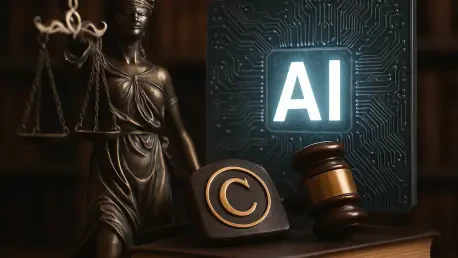

The United States legal system currently finds itself in a state of unprecedented paralysis as generative artificial intelligence evolves from a niche technological curiosity into a trillion-dollar cornerstone of the modern global economy. While engineers at major technology firms continue to push the boundaries of what large language models can produce, the federal statutes intended to protect intellectual property remain firmly anchored in the cultural and technological landscape of the late twentieth century. This widening chasm has resulted in a precarious legal vacuum where the ownership of billions of dollars worth of digital assets remains entirely undefined. The U.S. Copyright Office has become the reluctant front line of this conflict, processing over eleven thousand applications involving AI-assisted content since early 2023. Most of these filings exist in a state of provisional rejection or administrative limbo because the agency lacks a clear congressional mandate to recognize non-human authorship. Consequently, the very foundation of the creative industry is currently built on shifting sands, where the lack of enforceable rights threatens to stifle the very innovation that the technology was intended to accelerate. The absence of a binding federal statute means that businesses are operating without a safety net, forced to rely on improvisational legal strategies while waiting for a definitive resolution that may still be years away.
The Human Centric Foundation: A Conflict of Eras
The modern crisis of AI ownership is fundamentally a collision between twenty-first-century capabilities and the Copyright Act of 1976, which was drafted when the most advanced reproductive technology available was the basic photocopier. This foundational piece of legislation reflects an era where authorship was inextricably linked to human effort and physical labor, a concept that has been the bedrock of intellectual property for over a century. This human-centric requirement was most famously reinforced by the 1884 Supreme Court decision in Burrow-Giles Lithographic Co. v. Sarony, which established that creative works must result from human intellectual labor to receive federal protection. In that historic case, the court determined that a photograph was a protectable expression of the photographer’s original mental conception, rather than a mere mechanical reproduction. Today, the U.S. Copyright Office attempts to apply this nineteenth-century logic to neural networks that generate high-fidelity images and prose in seconds. The current administration has maintained that works produced entirely by an automated system without significant human intervention are ineligible for copyright. However, this rigid adherence to historical precedent fails to account for the iterative and complex nature of modern prompting, where a human creator may spend dozens of hours refining an AI’s output to match a specific artistic vision.
Building upon these historical constraints, the U.S. Copyright Office issued guidance in March 2023 that remains the primary operational framework for examiners in 2026. This guidance asserts that works containing AI-generated material must be evaluated to determine if the human creator exercised sufficient creative control over the final output. The primary challenge lies in the fact that the term “sufficient” remains a completely subjective and nebulous standard with no statutory definition or objective measurement. There is currently no bright-line threshold to determine when a user’s interaction with an AI—be it through multi-stage prompting, manual editing, or structural refinement—crosses the legal threshold into protectable authorship. This lack of clarity has birthed a patchwork of contradictory decisions across various federal districts, where an application rejected by one examiner might be viewed as registrable by a court in another jurisdiction. For creators, this means that the legal status of their work is often determined by the specific examiner or judge assigned to their case rather than a consistent national policy. This unpredictability creates a significant deterrent for professional artists who are hesitant to integrate generative tools into their workflow if the resulting assets cannot be legally defended against unauthorized use or reproduction by competitors.
Economic Destabilization: The Public Domain Threat
The legal ambiguity surrounding generative artificial intelligence has moved beyond the realm of academic debate and into the territory of tangible financial damage for corporations and individual creators alike. The central economic threat is the unprotectability of AI-assisted assets, which effectively forces these works into the public domain the moment they are released to the public. When a marketing agency or a global brand commissions an expensive advertising campaign featuring AI-generated imagery that lacks human authorship, those assets do not enjoy the standard seventy-year copyright protection. Consequently, competitors are legally permitted to scrape, reproduce, and repurpose those images for their own commercial gain without paying a licensing fee or seeking permission. This dynamic erases the competitive advantage that brands historically sought through original creative investment. By 2026, generative tools have been integrated into the workflows of roughly seven hundred million users globally, yet many of these participants are unaware that their output might be legally worthless in a courtroom. The massive investments being made into AI production pipelines are currently at risk because the “output” of these multi-million dollar systems lacks the fundamental characteristic of property: the right to exclude others from using it.
This economic fallout is particularly visible within the music and streaming industries, where the stakes of intellectual property are traditionally the highest. Major record labels are currently engaged in high-profile litigation against AI audio generation companies, arguing that the training processes—which involve the massive scraping of copyrighted recordings—constitute a form of systemic infringement. While these corporate giants fight for control over training data, independent musicians who utilize AI to enhance their compositions find themselves in a legal no-man’s-land. These artists often discover that their tracks are unlicensable to film studios or television networks because the status of the work as a “work of authorship” is in doubt. If a song cannot be copyrighted, a studio cannot safely purchase the exclusive rights to use it, leading to a complete breakdown in the licensing ecosystem. This environment creates a bifurcated market where traditional human-only content commands a premium for its legal stability, while AI-enhanced content, regardless of its quality, is treated as a high-risk asset. The inability to secure enforceable rights prevents small-scale creators from building sustainable business models, as they cannot prevent their work from being freely distributed by automated platforms that profit from content aggregation.
Global Regulatory Divergence: The American Impasse
While the United States remains locked in a cycle of administrative indecision, other major global economies have moved toward more structured and transparent frameworks for artificial intelligence. The most significant example is the European Union, where the comprehensive EU AI Act came into full effect in August 2025, providing a clear roadmap for developers and creators. This European framework mandates that any organization developing a general-purpose AI model must publish a detailed summary of the data used to train the system. This level of transparency allows copyright holders to exercise “opt-out” rights, a mechanism that effectively prevents their intellectual property from being used for machine learning without their consent. In contrast, the United States currently lacks any statutory requirement for training data disclosure or an opt-out infrastructure, leaving American creators as the only major group in the G7 without a clear path to protect their legacy works. Other jurisdictions, such as Japan and the United Kingdom, have also established distinct policies that prioritize either data mining exceptions or functional licensing models. This international divergence creates a fragmented global market where a piece of content might be protected in London but entirely unprotectable in New York, complicating the operations of multinational media companies.
The lack of a unified federal statute in the United States is primarily the result of a deep-seated legislative impasse within the halls of Congress. Since the current session began, multiple pieces of legislation, including the AI Labeling Act and the TRAIN Act, have been introduced with the goal of establishing a national standard for AI copyright. However, these efforts have stalled due to a fierce conflict between powerful technology coalitions and the traditional creative establishment. Technology firms, particularly those building massive large language models, resist any framework that would require retroactive licensing payments for the vast amounts of internet data used to train their current systems. Conversely, publishers, news organizations, and artist unions insist that any new law must include robust compensation mechanisms for the use of their intellectual property. This lobbying deadlock has shifted the immense burden of “making law” onto the federal judiciary, a task for which the courts are fundamentally ill-equipped. Judges are designed to resolve specific, narrow disputes between two parties based on existing laws; they are not designed to architect holistic, forward-looking technology policies for an entire economic ecosystem. This legislative inertia ensures that the legal vacuum will persist until a political compromise can be reached or a landmark case reaches the highest court.
Judicial Improvisation: Strategies for Risk Mitigation
In the absence of clear legislative direction, federal district court judges are being forced to improvise using legal tools that were never intended for the digital age. These courts are currently grappling with fundamental questions regarding the nature of creativity: does a three-hundred-word prompt constitute the “expression” of an idea, or is it merely a “suggestion” that the AI then executes? Some judges have begun to look at the act of selecting and arranging AI outputs as a form of curation that might qualify for a thin layer of copyright protection, similar to how an editor might copyright an anthology of public domain poems. However, this reliance on case-by-case adjudication leads to significant regional inconsistency. A developer in the Ninth Circuit, which covers the tech hubs of the West Coast, may encounter an entirely different legal interpretation than a creator in the Second Circuit in New York. This regional fragmentation makes it nearly impossible for startups to build stable business models, as their primary assets might be legally recognized in one state but not in another. Legal observers anticipate that this era of judicial experimentation will continue until the Supreme Court hears a definitive AI copyright case, an event that is not expected to occur until the 2026–2027 term at the very earliest.
To manage the risks inherent in this “undefined” legal environment, savvy creators and corporations have begun to adopt proactive documentation and contractual safeguards. Legal counsel now frequently recommends that any project involving generative AI must be accompanied by a “creative audit trail” that records every human decision made throughout the production process. This includes saving various versions of prompts, documenting manual edits made in software like Photoshop, and keeping a log of the human selection process used to filter AI outputs. By demonstrating a high degree of human intervention and creative control, stakeholders hope to provide the U.S. Copyright Office with the evidence necessary to secure a registration. Furthermore, commercial agreements are being rewritten to include explicit AI disclosure and indemnification clauses. These contracts attempt to allocate the financial risk of “unprotectability” before a project even begins, ensuring that all parties agree on who bears the loss if a court later determines the work cannot be copyrighted. While these strategies do not provide the same level of security as a federal statute, they offer a temporary bridge for businesses that must continue to operate within the legal gray zone. Meticulous record-keeping and clear jurisdictional choice in contracts have become the only tools available to mitigate the potential fallout of a sudden shift in judicial policy.
Strategic Directions for the Creative Economy
The overarching trend within the American intellectual property landscape was one of cautious adaptation to a “slow-motion crisis” that redefined the value of digital assets. Throughout the recent transition period, the word “undefined” became a functional reality for millions of creators who were forced to navigate a world without clear ownership rights. The impasse in Washington effectively ceding power to the judiciary meant that the legal definitions of authorship were built through a series of narrow, often conflicting court rulings rather than a cohesive national strategy. To succeed in this environment, organizations moved toward a model of hybrid authorship, where AI was used as a foundational tool but the final output was heavily modified by human hands to ensure a defensible copyright claim. This approach allowed for the efficiency of automated tools while maintaining the legal integrity necessary for commercial licensing. The most successful entities were those that treated AI not as a replacement for human talent, but as a sophisticated instrument requiring a high degree of documented human mastery to produce legally viable work.
Moving forward, stakeholders must prioritize the establishment of internal “IP provenance” systems that can withstand the scrutiny of both the Copyright Office and future litigation. This involves the implementation of technical watermarking and metadata standards that clearly distinguish between AI-generated foundations and human-authored layers. Additionally, industry leaders should continue to push for a federal “Transparency and Compensation” framework that could resolve the training data conflict through a compulsory licensing model, similar to those used in the early days of radio and digital music streaming. Such a system would provide the legal certainty required for long-term investment while ensuring that human creators are fairly compensated for the use of their work in machine learning datasets. Until such a national standard is codified, the primary strategy for any creative enterprise should be the diversification of intellectual property portfolios. By balancing AI-assisted projects with traditional human-authored works, companies can protect their core value from the volatility of the current legal vacuum. The transition to a post-AI copyright world was not a single event, but a protracted negotiation that required a fundamental rethinking of how society values the spark of original human expression.