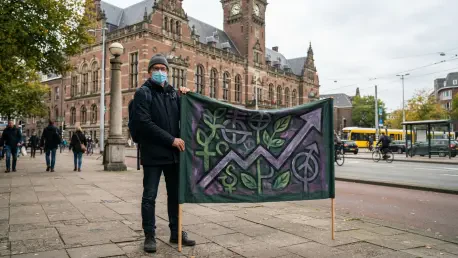

Daniels claims that despite his willingness to comply, he was pinned against a patrol vehicle and searched aggressively for carrying a political banner. This October 2026 legal action, known as Daniels v. Coos County, centers on an alleged violation of First and Fourth Amendment rights following a demonstration in Coquille. Seeking $75,000 in damages, the plaintiff, Neil Daniels, names a county commissioner and a police officer as defendants, asserting that his arrest was a calculated maneuver to stifle dissent. The case underscores a growing friction between local officials and constituents in an increasingly polarized climate where political slogans are frequently viewed as public disturbances. By examining the nuances of this litigation, observers can see how a simple act of protest evolved into a complex civil rights battle involving claims of excessive force and official overreach. The lawsuit aims to provide a definitive ruling on the boundary between speech and disorderly conduct today.
The Background of the Dispute
Professional Experience: Service and Insight
Neil Daniels is far from a novice in the realm of law enforcement, possessing a career that spanned nearly three decades before his retirement in 2017. His background includes service as a military police officer in the United States Army, followed by tenure as a police officer in the Oregon cities of Bandon and Roseburg. Additionally, he served as a parole and probation officer for both Douglas County and the Oregon Department of Corrections. This extensive professional history is a cornerstone of the litigation, as his legal team argues that his deep understanding of constitutional law and police procedure allowed him to recognize the exact moment his rights were being infringed upon. Unlike many civilians, Daniels was intimately familiar with the legal standards for arrest and the use of force, making his allegations of unnecessary rigor particularly poignant. His history suggests a person who respects the law but understands the limitations placed on those who enforce it.
Political Tensions: The Protester’s Motivation
The primary motivation for Daniels’ protest stemmed from the activities and public statements of Coos County Commissioner Rod Taylor. The lawsuit alleges that Taylor publicly acknowledged his presence at the United States Capitol during the events of January 6, 2021, an action Daniels viewed as inherently problematic for a public official. In response, Daniels began a routine of peaceful demonstrations outside the Owen Building, where the commissioner’s office is located. These protests were characterized by Daniels wearing a face mask that stated “Trump Lost, get over it” and carrying various political signs. Notably, prior to the incident that led to the lawsuit, local law enforcement agencies had specifically informed the county that Daniels was acting within his constitutional rights. This history of tolerated, peaceful dissent makes the sudden shift toward physical intervention on October 10, 2024, a central point of legal contention in the current 2026 proceedings as the court reviews evidence.
Escalation and Law Enforcement Intervention
The Confrontation: Incident at the Owen Building
On the day of the arrest, Daniels arrived at the Owen Building to protest a presentation hosted by Commissioner Taylor featuring a speaker he identified as an election denier. Despite the high tensions, Daniels initially maintained a low profile, keeping his “Trump Lost LOL” banner tucked in his pocket as he waited for the official event to commence. The litigation describes a scene where Daniels chanted political slogans but also showed courtesy by pausing when members of the public walked nearby. However, the atmosphere shifted dramatically when Commissioner Taylor allegedly approached Daniels. The complaint states that Taylor, who was visibly carrying a sidearm, moved to within inches of the plaintiff’s face while delivering verbal insults. This aggressive posture from an armed official created an immediate sense of danger for Daniels, who attempted to distance himself from the encounter. The firearm is a critical detail, as it elevated a verbal disagreement into a lethal threat.
Tactical Escalation: Proximity and Threat
The legal complaint argues that the interaction between the two men was defined by a significant power imbalance, with Taylor leveraging his political office to control the narrative. After the initial verbal exchange, Taylor contacted the Coquille Police Department to report that Daniels was harassing the public and creating a disturbance. Daniels’ legal counsel contends that this was a strategic misuse of emergency services designed to remove a political critic from the premises. During a second confrontation, the commissioner reportedly moved within two inches of Daniels once again, maintaining a threatening demeanor. Given the commissioner’s official capacity, his call to dispatchers carried a weight that influenced how responding officers perceived the scene before they arrived. This alleged manipulation of law enforcement resources is a primary factor in the claim that the subsequent arrest was pretextual rather than a legitimate response to a crime, highlighting official overreach.
Police Intervention: The Limits of Free Speech
When Officer Jessica Pierce arrived on the scene, the situation transitioned from a personal dispute between individuals into a state-sanctioned detention. Daniels, believing he had committed no legal infraction, attempted to leave the area but was quickly ordered to stop by the responding officer. A debate regarding the definition of a peaceful protest ensued, with Officer Pierce allegedly asserting that Daniels’ vocal chanting invalidated the protected nature of his demonstration. This disagreement highlights a fundamental conflict in civil rights law: at what decibel level or frequency does political speech become disorderly conduct? Daniels maintained that his actions were a standard exercise of his First Amendment rights, whereas the officer viewed his behavior as a public nuisance that required intervention. The lawsuit focuses on this specific interpretation, arguing that the officer lacked probable cause because the behavior was actually protected political expression in public.
Physical Custody: Allegations of Excessive Force
The escalation reached its peak when Officer Pierce proceeded to place Daniels under arrest. According to the lawsuit, Daniels expressed his willingness to surrender without resistance, yet the physical handling he experienced was described as overly aggressive. The complaint details how he was pinned against a patrol vehicle and searched with what is legally termed unnecessary rigor. During this process, the officer reportedly shouted “Stop resisting” to a compliant Daniels, a tactic often used to justify the use of force in police reports. Furthermore, the search resulted in the confiscation of the “Trump Lost LOL” banner, which was reportedly tossed into the trunk of the police cruiser with professional disdain. Daniels was eventually booked on a charge of second-degree disorderly conduct, but the prosecutor’s office ultimately declined to pursue the case. The lack of a subsequent prosecution is cited by the plaintiff as evidence that the initial arrest was legally groundless.
Legal Claims and Defense Arguments
Constitutional Litigation: Retaliation and Seizure
The civil rights lawsuit filed in late 2026 seeks to address three specific violations of law: the unlawful restriction of free speech, unreasonable seizure, and the use of unnecessary rigor. Daniels’ attorneys argue that the Oregon Constitution offers even more robust protections for political expression than the federal constitution, making the defendants’ actions a clear overreach. They contend that the arrest was a retaliatory act triggered specifically by the content of the plaintiff’s message, which was critical of local government leadership. By pursuing $75,000 in damages, the plaintiff aims to hold the City of Coquille and Coos County accountable for the training and conduct of their officials. The litigation serves as a formal challenge to the idea that a public official can use police power to silence political adversaries. The outcome will likely establish a higher bar for what constitutes disorderly conduct in the context of vocal demonstrations.
Official Defense: Denying Misconduct and Harassment
In response to the allegations, Commissioner Rod Taylor has remained steadfast in his denial of any wrongdoing. He argued that he never directed the police to arrest Daniels and that his actions were within the scope of his duties to ensure the Board of Commissioners could operate without interference. Taylor characterized Daniels’ long-term presence as a chronic disruption that impeded official business, including private executive sessions. Regarding the firearm, the commissioner defended his Second Amendment right to carry, stating that his daily habit of being armed is a personal choice unrelated to any intent to intimidate. He further noted that he had previously invited the plaintiff to participate in reasoned dialogue, but those attempts were allegedly rebuffed with hostility. The defense suggests that the arrest was a necessary reaction to a persistent nuisance rather than a suppression of speech, placing the burden on the court to define the limits of public harassment.
Judicial Precedents: Strengthening Civil Liberties
The resolution of the Daniels v. Coos County case provided essential clarity for the future of political expression in local jurisdictions. Legal experts recommended that municipalities update their training protocols to better distinguish between audible dissent and criminal disorderly conduct. By establishing a clear threshold for police intervention, the court helped prevent the weaponization of law enforcement by political figures. Officials considered the implementation of de-escalation zones and mandatory civil rights seminars for elected leaders to mitigate personal confrontations with protesters. The community sought to balance the safety of public buildings with the fundamental right to criticize government policy without fear of physical reprisal. Ultimately, the lawsuit reminded local agencies that constitutional protections remained paramount, regardless of the political climate. These insights ensured that future interactions between dissenters and the state were governed by law, fostering a resilient environment.