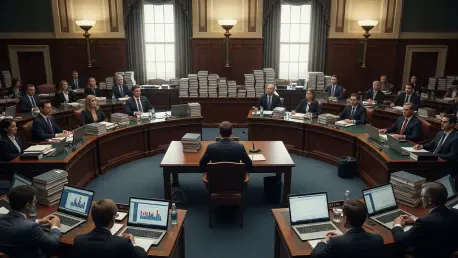

The intense friction between localized environmental litigation and federal legislative oversight reached a boiling point this week as a high-stakes congressional hearing scrutinized the financial and scientific foundations of a massive legal campaign against the world’s largest energy producers. This confrontation, staged within the halls of the House Judiciary Committee, has transformed a regional dispute into a national referendum on the boundaries of the tort system. At the center of this storm is a single private attorney whose ambitious legal strategy seeks to hold the fossil fuel industry financially liable for the catastrophic meteorological events that have increasingly plagued the Pacific Northwest. The decision to subpoena a private trial lawyer for a deposition regarding an ongoing case marks a dramatic escalation in how federal lawmakers interact with the judicial process. It signals a growing concern among some legislators that local government litigation is being used as a tactical “backdoor” to bypass federal policy-making, effectively creating a new regulatory landscape through the threat of astronomical damages rather than through the traditional legislative process.
The $51.5 billion demand filed by Multnomah County, Oregon, represents a unprecedented attempt to quantify the cost of a changing climate and transfer that burden onto corporate entities. Proponents of the lawsuit argue that this is a legitimate effort to recover funds for public infrastructure and health services necessitated by extreme weather. They see the courtroom as the last remaining venue where truth can be established through discovery and where accountability is finally possible after decades of legislative gridlock. However, the House Judiciary Committee’s Republican majority characterizes the effort as a politically motivated assault on a legal and regulated industry. They contend that the litigation is not about genuine recovery but is instead a “manufactured” legal crisis fueled by undisclosed funding and biased scientific research. This ideological divide highlights a fundamental question about the future of American governance: can a single personal injury attorney, armed with private capital and innovative science, effectively rewrite the rules for a global industry, or does such a move represent a dangerous overreach that threatens the separation of powers?
Can a Single Personal Injury Attorney Hold the Global Fossil Fuel Industry Accountable?
The current landscape of climate litigation has shifted from broad environmental appeals toward specific, quantifiable demands for financial reparations, creating a direct collision between local government authority and federal oversight. For years, the fossil fuel industry successfully navigated federal regulations, but the emergence of mass-tort strategies at the county level has introduced a new and unpredictable variable into their business models. The House Judiciary Committee’s decision to subpoena Roger Worthington, a private attorney leading the Multnomah County case, underscores the high stakes of this shift. This move by Congress is designed to investigate whether private legal firms are coordinating with public officials to exert undue pressure on the energy sector. Critics of the subpoena argue it is an intimidation tactic, while supporters believe it is a necessary check on what they describe as “regulation by litigation,” where the goal is not to win a trial but to force a massive settlement that alters national energy policy without a single vote in the Capitol.
The $51.5 billion price tag associated with the Multnomah County lawsuit is more than just a figure; it is a direct challenge to the financial viability of some of the world’s largest companies. This demand raises complex questions about the legitimacy of using tort law to address a global phenomenon like climate change. If a single county can successfully sue for damages related to a specific heat wave, it could open the floodgates for thousands of similar jurisdictions to seek compensation for every flood, fire, or drought. This prospect has galvanized the fossil fuel industry’s political allies, who view these lawsuits as a strategic maneuver to bankrupt an industry that is still essential to the American economy. The debate hinges on whether the legal system is equipped to handle “attribution science”—the methodology used to link specific corporate emissions to specific weather events—or if such science is merely a tool used by trial lawyers to create the appearance of causation where only correlation exists.
The Evolution of Roger Worthington: Bridging the Gap Between Asbestos Litigation and Climate Change
Roger Worthington’s professional journey provides a unique blueprint for the modern climate litigator, moving from the microscopic world of asbestos fibers to the global scale of atmospheric carbon. For over two decades, Worthington refined his skills as a billionaire asbestos litigator, building a fortune by proving that industrial giants were aware of the lethal risks of their products yet chose to ignore them. This experience taught him how to manage massive amounts of data, how to navigate the complexities of corporate disclosure, and how to tell a compelling story of victimization to a jury. By applying the “tobacco and asbestos model” to the fossil fuel industry, he is attempting to replicate past successes against corporate entities that were once thought to be untouchable. His transition into environmental advocacy is not just a change in focus but a strategic expansion of his existing legal philosophy, which treats corporate “deception” as the primary engine of public harm.
Beyond the courtroom, Worthington’s identity as a hops cultivator and the owner of Worthy Brewing in Bend, Oregon, informs his perspective on the environment. He views himself as a steward of the land who sees the direct impact of a warming climate on agriculture and water resources. His brewery, famously equipped with a “hopservatory” and high-powered telescopes, reflects a personality deeply invested in scientific inquiry. This personal interest in the empirical world drives his belief that scientific data is the ultimate weapon in the fight for accountability. For Worthington, the fossil fuel industry’s past actions mirror those of the asbestos manufacturers he once pursued: a pattern of internal knowledge clashing with public denial. The financial success he achieved in personal injury law has provided the substantial war chest necessary to fund a “David versus Goliath” battle against some of the most well-capitalized defendants in legal history. This independence allows him to bypass traditional funding constraints and pursue high-risk, high-reward litigation that many public prosecutors would find too daunting.
Anatomy of a $51 Billion Lawsuit: Attribution Science, Contingency Fees, and Allegations of Deception
The Multnomah County case is built upon a sophisticated legal architecture that relies on private firms working on a contingency basis, a model that allows the county to pursue litigation without risking taxpayer funds. In this arrangement, the legal teams absorb all the costs of the multi-year battle in exchange for a percentage of any eventual settlement or verdict. While this democratizes access to justice for local governments, it also invites intense scrutiny regarding the profit motives of the attorneys involved. Critics argue that this creates a “litigation machine” where the primary goal is a massive payout rather than public policy. The lawsuit’s structure is designed to weather-proof the county’s future by seeking damages specifically for the deadly 2021 Pacific Northwest heat dome, an event that became a defining moment for the region. By tying the litigation to a single, devastating event, the legal team aims to move the conversation from abstract environmental concerns toward tangible, quantifiable losses that a jury can easily comprehend.
At the heart of the evidentiary case is “attribution science,” a burgeoning field that attempts to calculate how much human-induced warming increased the probability of specific weather disasters. The lawsuit alleges that without the historical emissions from the defendant companies, the 2021 heat dome would have been virtually impossible. This scientific pillar is supported by two other central claims: the need for massive investment in weatherproofing public infrastructure and the cost of bolstering public health systems to manage heat-related illnesses. Furthermore, the complaint details a decades-long “deceptive marketing” campaign, alleging that the fossil fuel industry intentionally sowed doubt about climate science to preserve its market share. This shift in legal strategy—focusing on deception rather than just pollution—is a calculated move to overcome the traditional defense that everyone contributes to carbon emissions. By isolating the industry’s alleged “misinformation” as a unique tort, the lawsuit seeks to frame the defendants not just as emitters, but as dishonest actors who prevented a timely transition to cleaner energy.
Judicial Scrutiny and Congressional Grilling: The Debate Over Scientific Integrity and Hidden Funding
The momentum of the Multnomah County case hit a significant hurdle when Judge Benjamin Souede issued a sharp rebuke regarding the legal team’s disclosure practices. The judge described as “gobsmacking” the failure of Worthington and his associates to alert the court to their financial ties to researchers whose work was being cited as evidence. This judicial scolding provided the necessary political opening for the House Judiciary Committee to launch its inquiry, focusing on whether the “independent” science used in climate lawsuits is actually being quietly commissioned by the very lawyers filing the cases. The core of the GOP-led investigation centers on allegations of “prejudice” within the legal ecosystem, specifically pointing to the Environmental Law Institute and its programs that provide climate education to judges. Lawmakers are investigating whether these programs are neutral educational tools or a sophisticated form of judicial lobbying intended to tilt the scales of justice toward environmental activists before a trial even begins.
During the congressional grilling, the ideological battle lines were clearly drawn between Representative Darrell Issa’s critique of “manufactured” science and Representative Jamie Raskin’s defense against what he termed an “outrageous abuse of power.” Issa and his colleagues argued that the legal team’s failure to disclose funding for scientific papers undermines the integrity of the entire judicial process. They contend that if lawyers are paying for the science that proves their case, the evidence is no longer objective. In contrast, Raskin and other Democrats characterized the subpoena as a desperate attempt by “Big Oil” to use its political influence to derail a legitimate court proceeding. They argued that the fossil fuel industry is using its own vast resources to conduct “opposition research” against climate scientists, effectively harassing researchers into silence. This multi-front war—occurring in state courts, federal oversight committees, and the public square—demonstrates how the climate crisis has transcended the realm of ecology to become a permanent fixture of legal and political warfare.
Strategic Guidelines for Ensuring Ethical Transparency in High-Stakes Public Interest Litigation
To maintain the credibility of high-stakes litigation, legal teams must adopt rigorous protocols for disclosing financial relationships between counsel and scientific researchers. The recent controversies demonstrate that even the appearance of a conflict of interest can jeopardize years of legal work and provide ammunition for political opponents. Establishing a “wall of separation” between the funding of research and the drafting of legal complaints is essential for ensuring that evidentiary science can withstand the most intense judicial and legislative scrutiny. This includes proactive disclosure of any grants, consulting fees, or logistical support provided to expert witnesses or the institutions that publish their findings. By normalizing full transparency, the legal community can protect the integrity of “attribution science” and ensure that the focus remains on the empirical data rather than the financial ties of the people presenting it. Such measures are vital for preserving public trust in a tort system that is increasingly being asked to resolve the most complex challenges of the modern era.
Navigating the “contingency fee” model in cases involving public infrastructure requires a delicate balance between private incentives and the public interest. While this model is often the only way for cash-strapped municipalities to seek justice against global corporations, it must be governed by strict oversight frameworks that prevent “litigation for profit” from overshadowing the needs of the community. Best practices include clear, public-facing contracts that outline the attorney’s fees and ensure that the majority of any recovery is dedicated to the infrastructure and health services it was intended to fund. Furthermore, managing multi-front legal battles involving state courts, federal regulators, and hostile legislative committees requires a holistic strategy that anticipates political pushback. Stakeholders developed frameworks to vet experts more thoroughly and to prepare for the inevitable “opposition research” that now accompanies climate litigation. The legal community recognized that in the arena of high-stakes public interest law, the battle for public opinion and ethical standing is just as important as the battle for the final verdict in the courtroom.
The conclusion of the congressional hearing regarding Roger Worthington’s climate litigation marked a definitive shift in the landscape of environmental law. The testimony provided a rare glimpse into the complex machinery that drives billion-dollar tort claims, revealing both the innovative scientific strategies and the ethical pitfalls that define this new era of accountability. Lawmakers who scrutinized the proceedings were forced to grapple with the reality that local governments are no longer waiting for federal action to address the rising costs of weather-related disasters. The legal community responded by implementing more stringent disclosure requirements, ensuring that the link between advocacy and inquiry remained transparent to both judges and the public. This period of intense oversight ultimately clarified the standards for attribution science, requiring that it stand up to the rigors of cross-examination without the shadow of undisclosed funding. As these cases moved toward their respective trials, the focus transitioned from the conduct of the attorneys to the conduct of the industries they sought to hold responsible. The precedent established during this conflict ensured that future litigation would be judged on the strength of its evidence and the clarity of its ethics, rather than on the political theatre surrounding its inception. In the end, the scrutiny of the House Judiciary Committee functioned as a crucible, refining the methods used by those who sought to use the courts as a tool for planetary-scale justice. This evolution in the legal process allowed for a more grounded debate on how society as a whole distributed the immense costs of a changing environment. In the years following the grilling, the legal landscape became more predictable, with established rules for how private firms and public entities could collaborate on issues of global importance. The struggle over the Multnomah County lawsuit served as the final chapter in the era of unregulated climate litigation, ushering in a period of heightened transparency and more disciplined legal advocacy. This shift proved that while the scales of justice could be slow to move, they were capable of adapting to the complexities of a new century. Stakeholders from across the political spectrum eventually acknowledged that the courtroom remained a vital, if contentious, arena for resolving the most difficult questions of our time. The actions taken during this period of oversight provided a roadmap for how to manage the intersection of private law and public policy, ensuring that the quest for corporate accountability did not come at the expense of judicial integrity. In the final analysis, the grilling of Roger Worthington was the catalyst that forced the legal system to grow alongside the challenges it was built to address.