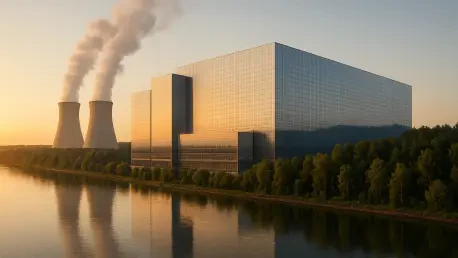

Supreme Court precedents have made it nearly impossible for private citizens to challenge data center permits under Title VI of the Civil Rights Act without proving rare “intentional discrimination.” This legal landscape presents a significant hurdle at a moment when the United States is undergoing a seismic shift in industrial prioritization, as artificial intelligence transitions from a speculative technological frontier to the primary driver of national economic policy. As the demand for generative models and automated systems reaches a fever pitch, the physical infrastructure required to sustain these computations is expanding at an unprecedented rate, often outpacing the regulatory frameworks intended to safeguard the environment. These data centers, once considered relatively benign office-like structures, are now massive industrial complexes with energy footprints that rival small cities and water requirements that can strain entire regional aquifers. The federal government, eager to maintain a competitive edge in the global AI race, has frequently prioritized speed and deregulation over the rigorous application of existing environmental protections. This has created a critical tension between the technological advancement of the country and the health of the local communities that host these facilities. Without a comprehensive and modernized federal strategy to address the unique environmental impacts of AI infrastructure, the nation risks a crisis where the digital future is built upon a foundation of ecological degradation and social inequity.
Environmental Justice and the Burden of Cumulative Harm
Historical Directives and Modern Policy Shifts
The foundations of environmental justice in the United States were built on the fundamental recognition that industrial hazards and pollution sources are overwhelmingly concentrated in low-income and minority neighborhoods. For several decades, legal frameworks like Executive Order 12898 served as the cornerstone of federal efforts to mitigate these disproportionate impacts by requiring agencies to identify and address the high and adverse human health or environmental effects of their programs on minority and low-income populations. This directive was intended to ensure that the permitting of major industrial projects did not simply follow the path of least political resistance, which often led to the clustering of hazardous facilities in communities that lacked the resources to mount a prolonged legal or administrative defense. By embedding these considerations into the federal decision-making process, the government acknowledged that environmental health is a civil right and that the burden of industrial progress should not fall unfairly on the shoulders of the most vulnerable.
However, a recent and controversial shift in federal policy has seen a systematic rollback of these critical environmental justice mandates, leaving a significant void in oversight that directly affects the siting of AI data centers. The revocation of key directives that once compelled federal agencies to prioritize the well-being of overburdened populations means that current permitting processes often ignore the “total weight” of pollution a community already carries. This policy shift has effectively moved the regulatory environment toward a “landscape of disclosure,” where transparency exists in a purely formal sense without the corresponding power to enact meaningful change or stop harmful projects. While residents in high-impact zones may still be permitted to provide public testimony during comment periods, they frequently find themselves without the legal standing or administrative leverage necessary to prevent new, energy-intensive projects that push local air or water pollution levels beyond safe thresholds.
Statutory Gaps and the xAI Case Study
A prominent example of this regulatory friction is found in Southaven, Mississippi, where the development of a massive $20 billion xAI facility has highlighted the ease with which large-scale technology projects can exploit specific loopholes in the Clean Air Act. This project, designed to house some of the most powerful supercomputers in existence, demonstrates how developers can utilize creative legal classifications to bypass the rigorous environmental reviews typically required for heavy industrial sites. By framing the project as a necessary leap for national technological supremacy, developers have been able to move forward with minimal traditional oversight, raising concerns among local advocates about the long-term health implications for the surrounding population. This case serves as a warning that without specific, updated statutory language that accounts for the unique operational profiles of massive data centers, the current environmental laws may prove insufficient to protect public health in the age of rapid AI expansion.
At the heart of the ongoing dispute surrounding the xAI facility is the technical classification of dozens of natural-gas turbines as “portable” or “nonroad” engines rather than permanent stationary sources. This specific legal distinction is crucial because it allows the facility to avoid the comprehensive preconstruction reviews and operating permits that would normally be required for a project of this magnitude. Despite these turbines operating around the clock to provide the massive electrical load required for AI training, their classification as portable hardware effectively exempts them from the most stringent air quality standards. Consequently, the facility is projected to emit significant amounts of nitrogen oxide and formaldehyde into an area that is already grappling with existing industrial pollution. Current federal law lacks a definitive, enforceable threshold for “cumulative burden,” making it nearly impossible for local residents to successfully argue in court that the combined impact of new and old pollution sources has become unacceptable.
Limitations of Procedural Safeguards and Civil Rights
Existing environmental tools, most notably the National Environmental Policy Act (NEPA), have proven increasingly insufficient in the face of the AI infrastructure boom because they are designed as procedural rather than substantive safeguards. NEPA requires federal agencies to take a “hard look” at the potential environmental consequences of their actions, but it does not actually mandate that an agency select the most environmentally friendly or least harmful path. This means that as long as the federal government follows the correct administrative steps—such as publishing environmental impact statements and holding public hearings—it can legally approve projects that cause significant environmental damage. For data center projects that involve federal funding or permits, the process often becomes a bureaucratic exercise in documentation rather than a genuine effort to minimize the ecological footprint or protect the long-term health of neighboring communities.
Furthermore, many AI data centers are constructed on private land with local economic incentives, meaning they often lack a “federal nexus” that would trigger NEPA review in the first place. Without the involvement of a major federal action, these massive projects can entirely avoid the centralized environmental scrutiny that federal law would otherwise provide, leaving oversight to a patchwork of local and state regulations that are often ill-equipped to handle the technical complexity of AI operations. Civil rights protections, which were once seen as a final safeguard against environmental racism, have also been weakened by a series of court rulings that limit the ability of private citizens to sue for “disparate impact.” Following the Supreme Court’s decision in Alexander v. Sandoval, residents can no longer challenge a project simply because it causes a statistically significant and disproportionate harm to a specific racial or ethnic group, further insulating developers from accountability.
Local Governance as a Final Resort
In the absence of a robust and proactive federal response, some local communities have begun to leverage land-use laws and municipal zoning as a last line of defense to protect their interests against industrial overreach. Municipal zoning remains one of the few legal arenas where the cumulative burden of a project, including its impact on traffic, noise, and local utility capacity, can lead to the outright rejection of a data center proposal. Because local officials are directly accountable to their constituents, they are often more sensitive to the immediate quality-of-life concerns that federal regulators might overlook in their pursuit of broader national objectives. This shift toward localism reflects a growing realization that the current federal legal framework is prioritizing the speed of AI deployment over the safety and stability of the communities that must live alongside these massive computing hubs.
The recent success of voters in Monterey Park, California, who successfully used a local referendum to block a proposed data center development, illustrates this emerging trend of grassroots resistance. This victory demonstrates that when federal and state laws prioritize industrial expansion at the expense of local well-being, organized community movements can become the primary defense against the encroachment of heavy digital infrastructure. However, relying on a city-by-city or county-by-county approach to regulate a national technological shift creates an inconsistent and unpredictable landscape for both residents and developers. While local victories provide temporary relief for specific neighborhoods, they do not address the systemic federal inaction that allows the AI industry to continue expanding without a unified set of environmental and social standards that apply to all projects regardless of their location.
The Economics of Grid Integration and the Federal Power Act
The Conflict Between Energy Expansion and Regulation
The push to usher in a “golden age” of artificial intelligence through the deregulation of infrastructure projects often clashes directly with the statutory obligations of the Federal Energy Regulatory Commission (FERC). While recent executive orders and federal initiatives have called for the removal of administrative burdens to speed up the construction of new power sources, FERC is legally bound by the Federal Power Act to ensure that the energy market remains fair, transparent, and non-discriminatory. The scale of electricity demand from facilities like xAI’s Colossus 2 is so massive that it often consumes as much power as an entire mid-sized city, creating an immediate and severe strain on the existing electrical grid. This sudden surge in demand necessitates the construction of expensive new transmission lines and substations, creating a regulatory dilemma over who should be held responsible for the billions of dollars in infrastructure costs.
This tension is exacerbated by the fact that the electrical grid was not originally designed to accommodate the hyper-concentrated loads required by modern AI training clusters. Unlike traditional industrial factories that might scale their energy use over several years, data centers can come online with massive power requirements in a matter of months, leaving utility companies and regulators struggling to maintain grid stability. When FERC attempts to implement stricter oversight to prevent localized blackouts or price volatility, it often finds itself at odds with federal agencies focused on rapid tech deployment. The result is a regulatory environment characterized by uncertainty, where the long-term reliability of the American power grid is being traded for short-term gains in computing capacity. This conflict highlights the urgent need for a modernized Federal Power Act that explicitly addresses the unique challenges posed by the AI sector’s insatiable hunger for electricity.
Mechanisms of Financial Cost-Shifting
A primary concern for utility regulators and consumer advocates is the pervasive practice of “cost-shifting,” where the immense expense of upgrading the electrical grid for a single large AI customer is effectively shared by all ratepayers in a given region. When a utility company builds new high-voltage lines or upgrades transformers to serve a 500-megawatt data center, the costs of those capital improvements are often recovered through general rate increases that affect every household and small business in the service area. This can lead to dramatic and unexpected spikes in monthly utility bills for local residents, many of whom receive no direct economic benefit from the nearby data center. This financial arrangement creates an invisible subsidy for the AI industry, where the public pays to build the infrastructure that private tech companies use to generate vast profits.
The Federal Power Act mandates that electricity rates must be “just and reasonable” and strictly prohibits utility companies from granting “unreasonable preferences” or creating significant differences between different classes of service. Shifting the financial burden of AI-driven grid expansion onto residential consumers potentially violates these core legal principles by forcing the general public to bear the risk and cost of a private enterprise’s specialized infrastructure needs. Precedents in federal court have established the “cost-causation” principle, which asserts that utility costs should be allocated based on which customers actually cause the need for the upgrades and who benefits from them. Since data centers are often highly automated and provide limited long-term local employment compared to their energy use, requiring residents to subsidize their energy infrastructure fails the fundamental fairness test that federal law was designed to uphold.
Regulatory Solutions for Market Equity
One potential path forward for ensuring market equity in the age of AI is for the Federal Energy Regulatory Commission to mandate the creation of entirely separate rate classes for high-load, energy-intensive industrial customers. By categorizing AI data centers as a distinct class of electricity user, regulators could prevent their massive energy needs from being averaged into the basic monthly bills of families and small businesses. This would allow for a more transparent accounting of the costs associated with the AI boom, ensuring that the developers of these facilities pay a rate that truly reflects the strain they place on the grid and the cost of the dedicated infrastructure required to serve them. Such a move would align with the “beneficiary pays” model of utility regulation, protecting the most vulnerable consumers from the inflationary pressure of the digital economy’s energy requirements.
In addition to rate reform, federal regulators could utilize existing reliability standards to require AI data center developers to internalize all costs associated with their connection to the grid. This “interconnection reform” would mean that just as a traditional manufacturing plant must pay for the specific industrial upgrades it needs to operate safely, AI developers would be held financially responsible for maintaining the stability and affordability of the local electrical system. By requiring these companies to invest in their own on-site power generation or grid-balancing technologies, the federal government could ensure that the expansion of AI does not come at the expense of national energy security. Implementing these changes would move the industry away from its current reliance on public subsidies and toward a more sustainable model where the true cost of technology is reflected in the balance sheets of the companies that profit from it.
Chemical Safety and the Toxic Substances Control Act
Addressing Toxic Materials in AI Hardware
As the scale of AI infrastructure continues to grow, data centers are becoming significant users of chemical substances that are strictly regulated under the Toxic Substances Control Act (TSCA). These facilities have transitioned from simple server rooms into massive industrial sites that operate with a level of chemical intensity comparable to traditional chemical factories, necessitating a more stringent level of federal oversight than currently exists. One of the most pressing concerns involves the liquid cooling systems required to keep high-performance AI chips from overheating. These systems often rely on specialized coolants that contain PFAS, or per- and polyfluoroalkyl substances, which are widely known as “forever chemicals” due to their persistence in the environment and their link to serious human health issues. Despite their risks, the specific use of these chemicals in data center cooling loops has faced surprisingly minimal targeted enforcement or specialized regulation.
Beyond the challenges of cooling, the heavy reliance on massive battery arrays for uninterruptible power supplies and the rapid turnover of server hardware introduces large concentrations of lead, lithium, and various flame retardants to single locations. When these materials are concentrated at the scale of a modern AI hub, they present significant long-term risks to local soil and air quality if they are not managed properly throughout their entire lifecycle. The current federal approach to chemical safety has largely focused on the point of manufacture, but the operational life of a data center creates a continuous risk of leaks, spills, and atmospheric venting that has yet to be fully addressed by the Environmental Protection Agency. As the AI industry continues its rapid expansion, the lack of a comprehensive chemical management strategy for these facilities represents a growing threat to the environmental integrity of the regions that host them.
Closing the Enforcement Gap in Waste Disposal
The management of electronic waste and wastewater discharge represents another critical enforcement gap that federal regulators must close to prevent a long-term environmental crisis. A major source of concern is the disposal of “cooling tower blowdown” water, which is the wastewater periodically flushed from cooling systems to prevent the buildup of minerals and contaminants. This wastewater often contains high concentrations of treated borates, nitrites, and other chemical additives that can eventually enter municipal sewage systems or local waterways if not properly treated. Despite the potential for these discharges to harm aquatic life and contaminate local water supplies, the Environmental Protection Agency has not yet fully applied its authority to regulate these specific industrial discharges from data centers, often leaving the task to overwhelmed local water authorities.
Finally, the sheer volume of electronic waste generated by the AI industry, where servers and hardware are often retired and replaced every few years to maintain peak performance, highlights the urgent need for better reporting and tracking under the Toxic Substances Control Act. By requiring data center operators to provide detailed disclosures regarding their chemical use, production volumes, and waste management practices, the federal government could finally bring the AI infrastructure sector into compliance with basic public health and safety standards. Implementing a robust “cradle-to-grave” tracking system for the hazardous materials used in AI hardware would ensure that the digital revolution does not leave behind a legacy of toxic waste. Strengthening these enforcement mechanisms would signal to the industry that technological leadership must be accompanied by a commitment to environmental stewardship and the protection of the communities that sustain it.
Actionable Paths Toward Sustainable Digital Growth
The historical development of AI infrastructure followed a path of least resistance that prioritized rapid deployment over environmental and social safeguards. Legal experts and environmental advocates observed that the lack of a cohesive federal framework allowed massive data centers to emerge as industrial entities without the corresponding regulatory burdens typically associated with heavy manufacturing. This period of unchecked growth eventually reached a breaking point, where the cumulative impact on the electrical grid and local ecosystems became impossible to ignore. The federal government finally recognized that the existing statutes, many of which were drafted decades before the concept of generative AI existed, required significant modernization to address the realities of the modern digital economy. This realization led to the initial drafting of several legislative reforms aimed at closing the loopholes in the Clean Air Act and the Federal Power Act that had previously benefited large-scale technology developers.
Moving forward, the primary solution resided in the establishment of a centralized federal AI infrastructure office tasked with coordinating environmental reviews across multiple agencies. This new approach moved the nation away from the “landscape of disclosure” and toward a model of substantive accountability, where project approval was contingent on meeting strict cumulative impact thresholds and grid stability requirements. Industry leaders were encouraged to adopt closed-loop cooling systems and on-site renewable energy generation to mitigate their local footprint, while FERC implemented mandatory cost-allocation rules that protected residential ratepayers from the expenses of industrial grid upgrades. By transitioning the AI sector into a more mature and responsible industrial class, the government successfully balanced the need for technological progress with the non-negotiable requirement of environmental justice. These steps ensured that the digital transformation of the economy was built on a sustainable foundation that preserved public health for generations to come.