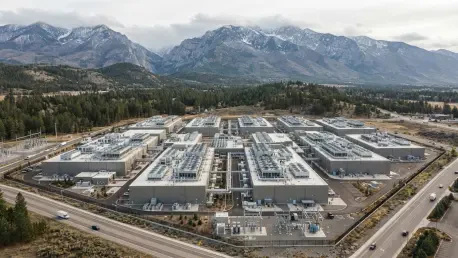

The global landscape of digital infrastructure is currently fracturing under the weight of an unprecedented energy demand that has forced industry titans to fundamentally reinvent the very concept of the data warehouse into something far more industrial and energy-intensive. This transformation marks the most significant evolution of the industry since the cloud first emerged, moving away from passive storage toward active computational power. These facilities are no longer merely repositories for cold data but have become the physical engines of the artificial intelligence revolution. As the search for high-density computing capabilities intensifies, the primary focus of development has shifted toward the creation of massive AI compute campuses that can handle the rigorous demands of the next generation of digital services.
Major market leaders, such as Microsoft, Google, and OpenAI, are aggressively pursuing this new architecture to support the surge in specialized hardware requirements. This transition is not just a technological upgrade but a fundamental redesign of site requirements, emphasizing massive power densities and advanced liquid cooling systems that far exceed the capabilities of traditional enterprise centers. This evolution has brought the industry to a critical intersection where the physical necessities of high-performance computing must contend with a tightening environment of local and national regulations. The resulting friction is reshaping how projects are planned, labeled, and presented to the public.
Strategic necessity now dictates that companies look beyond the standard data center model to secure the resources required for superintelligence training. The scale of these campuses involves a total rethink of infrastructure integration, often requiring dedicated energy generation and a higher degree of physical fortification. Consequently, the industry is seeing a move toward vertically integrated sites that function more like manufacturing plants than utility buildings. This structural change is designed to meet technical goals while navigating the complex regulatory hurdles that threaten to slow down the rapid deployment of artificial intelligence assets.
The Strategic Shift in Global Digital Infrastructure
The core of the current industry transformation lies in how digital infrastructure is conceptualized by both developers and the public. In recent years, the standard cloud facility has reached its limits in terms of energy efficiency and cooling capacity, leading to a bottleneck in the deployment of high-performance GPUs. To solve this, developers are pivoting toward high-density configurations that allow for the concentration of thousands of processing units within a single footprint. This shift requires a move away from traditional air-cooling methods to liquid-to-chip technology, which drastically alters the physical profile and utility consumption of these buildings.
Furthermore, the integration of power management has become a primary driver of site selection and design. Unlike the cloud storage facilities of the past decade, modern compute campuses require immediate access to gigawatt-scale energy resources. This demand has led to a strategic focus on locations where power grids can be augmented by on-site generation, such as small modular reactors or large-scale battery storage arrays. The industry is moving toward a model of self-sufficiency to mitigate the risks of grid instability and local utility constraints. This move toward energy independence is a hallmark of the new era of digital infrastructure.
This strategic pivot is also motivated by the need to secure a more favorable position within the broader industrial economy. By aligning data center development with the goals of national industrial policy, firms are attempting to distance themselves from the negative connotations of windowless, low-employment warehouses. The new focus is on being perceived as vital components of the manufacturing and research sectors, which often carry greater political weight and offer more robust legal protections. This repositioning is central to the industry’s attempt to remain resilient in a climate of increasing public and regulatory scrutiny.
Emerging Trends and Market Performance Indicators
The Transition to High-Density Compute Campuses
One of the most visible trends in the current landscape is the deliberate rebranding of large-scale facilities from data centers to compute campuses or superintelligence manufacturing sites. This linguistic shift is closely tied to the technical reality of modern hardware, where energy consumption per rack has increased by an order of magnitude. By adopting terms like manufacturing, developers are attempting to signal that their facilities are productive industrial hubs rather than just storage sites. This strategy allows companies to petition for economic incentives and zoning variances that were historically reserved for high-employment sectors like the semiconductor or automotive industries.
This transition also reflects a move toward more integrated facility designs that include on-site research laboratories and hardware testing zones. By blending the lines between traditional office space, research labs, and high-density compute halls, developers can argue that their projects provide a more diverse set of economic benefits to the local community. The physical architecture of these sites is changing to accommodate these mixed uses, with a focus on liquid cooling infrastructure that is often hidden behind more traditional manufacturing facades. This architectural camouflage is a strategic response to zoning laws that were written before the advent of AI-driven computing.
Economic Projections for the AI Infrastructure Sector
The current economic cycle is defined by a massive influx of capital into infrastructure that supports advanced machine learning and autonomous systems. Global spending on these facilities is projected to reach trillions of dollars as the race for computational supremacy accelerates. In major hubs like Hillsboro, Oregon, and Northern Virginia, the market is seeing a shift in how performance is measured, with investors now focusing more on megawatt capacity than on total square footage. This change in metrics reflects the fact that a smaller, high-density building can now provide more computational value and generate more revenue than a much larger traditional data center.
Performance indicators suggest that while physical land availability remains a constraint, the productivity of that land is increasing through vertical density and specialized hardware. In many markets, the energy draw per acre is expected to triple over the coming years as older facilities are decommissioned and replaced with AI-specific hardware. This intensification of land use is creating a new set of economic realities where the value of a site is tied directly to its proximity to high-capacity transmission lines. This trend is expected to continue as the industry moves toward a super-cycle of construction that will define the digital economy for the next several years.
Overcoming Structural and Regulatory Obstacles
The industry is currently facing a significant political challenge in the form of a widespread voter revolt against the expansion of digital infrastructure. Concerns over rising utility costs for residential customers and the massive water consumption required for cooling have become major talking points in local politics. This has led to a climate where new projects are often met with organized opposition from community groups who feel that the environmental and financial burdens of these facilities are not being fairly shared. To counter this, some companies have begun using voluntary community compacts that promise various benefits, but these agreements are often non-binding and subject to skepticism.
Technological hurdles are also complicating the regulatory picture, particularly as the aging power grid struggles to keep up with the demands of high-density clusters. In many regions, the timeline for utility upgrades can extend several years into the future, creating a significant barrier to entry for new projects. To bypass these grid constraints, developers are increasingly looking at independent power solutions, including the deployment of on-site clean energy assets. However, building these energy sources often brings its own set of regulatory challenges, as local zoning boards may not be equipped to handle the complexities of on-site nuclear or industrial-scale battery systems.
To mitigate friction with local governments, firms are attempting to provide more transparent data regarding their impact on municipal resources. However, the effectiveness of these efforts is often undermined by a lack of standardization in how resource consumption is reported. Critics argue that without mandatory reporting requirements and binding performance standards, the industry will continue to operate in a way that prioritizes corporate growth over community stability. The challenge for developers in the current year is to find a way to align their expansion goals with the increasingly vocal demands of local stakeholders who are wary of the long-term impacts of large-scale compute projects.
The Evolving Regulatory Landscape and Compliance Standards
Local Governance and the Limitations of Activity Labels
A major point of contention in the current regulatory environment is the reliance of local jurisdictions on activity labels rather than physical load when drafting zoning laws. In many cases, current frameworks categorize facilities based on the name of the business or a general description of the work being done, rather than the actual megawatt load or water draw of the site. This creates a significant vulnerability that developers can exploit through accessory-use loopholes. For example, a project might be permitted as a research and development site or a manufacturing plant, while the vast majority of its resource consumption comes from high-density AI clusters tucked away inside.
This labeling gap allows facilities to bypass acreage caps and environmental buffer zones that were specifically designed to limit the growth of the data center sector. When a facility is classified as manufacturing, it may be exempt from the stricter standards applied to data storage, even if its physical impact on the local power grid is identical or even greater. Local officials are finding it difficult to keep pace with these linguistic maneuvers, as the technical complexity of the hardware makes it hard to define where research ends and industrial computing begins. This has led to a push for new regulations that focus on the physical reality of a building’s operation rather than its marketing description.
The Role of Security and Compliance Measures
Security and compliance have moved to the forefront of the regulatory discussion as AI infrastructure is increasingly viewed through the lens of national sovereignty. Federal mandates are beginning to prioritize the protection of high-performance compute assets as a matter of national security, which adds another layer of complexity to the local zoning process. This shift toward the physical fortification of energy and data assets means that facilities are becoming more isolated from their surrounding communities. The need for heightened security can lead to designs that resemble high-security industrial compounds, which often clash with local land-use goals focused on residential or light-industrial harmony.
Compliance now involves navigating a landscape where the distinction between private enterprise and national industrial policy is becoming blurred. As the federal government moves to protect superintelligence infrastructure, local authorities may find their zoning powers curtailed by mandates that prioritize the rapid deployment of technology. This tension between municipal control and national interests is a defining feature of the regulatory landscape in 2026. Developers must now consider how their projects fit into a broader national security framework, which can influence everything from the choice of subcontractors to the types of energy systems installed on-site.
Future Directions in AI Infrastructure and Global Policy
Federal Preemption and the Rise of Superintelligence
The industry is rapidly approaching a point where federal intervention could become the primary way to bypass local development bottlenecks. By designating AI infrastructure as a critical pillar of domestic industrial policy, national governments have the potential to render local land-use restrictions secondary to the needs of the state. This move toward federal preemption is being driven by the race for technological supremacy, where any delay in infrastructure deployment is seen as a risk to national competitiveness. Under this model, the term superintelligence is being used to categorize a new class of high-priority facilities that are exempt from the standard regulatory grind.
This shift has profound implications for how projects are approved and built, as it effectively creates a fast-track for facilities that align with federal goals. For municipalities, this could mean losing the ability to limit the size or resource consumption of large-scale compute sites within their borders. Innovations in energy, such as the deployment of small modular reactors, are expected to play a central role in this federalized development model, providing the necessary power to these high-priority zones without straining local residential grids. This trend toward nationalized industrial planning represents a major departure from the traditionally local nature of land-use regulation in the United States.
Innovation and Changing Consumer Preferences
Future growth in the sector will likely be determined by a firm’s ability to demonstrate grid neutrality or a positive community impact. Consumer and voter preferences are shifting toward requiring companies to provide upfront financial collateral for the infrastructure upgrades their projects necessitate. We are seeing a movement away from the historical model of tax abatements toward a regulatory environment that demands more from corporate citizens in exchange for the right to build. Transparency in reporting energy density and resource consumption is becoming a non-negotiable requirement for many communities that have seen their utility bills rise in tandem with the arrival of major tech facilities.
As global economic conditions continue to favor the rapid scaling of AI, firms that can navigate these changing preferences will be the most successful. This involves moving beyond marketing shell games and toward a policy of radical transparency regarding the physical impact of high-density computing. The race for AI supremacy will likely continue to accelerate these trends, favoring projects that can prove they are not a drain on local resources. In the coming years, the industry must adapt to a world where the social license to operate is just as important as the availability of land and power, requiring a new level of engagement with the communities that host these massive digital engines.
Summary of Findings and Strategic Outlook
The analysis of the current infrastructure landscape demonstrated that the strategic rebranding of data centers into compute campuses was a direct response to a tightening regulatory environment and increased public scrutiny. It was found that while these linguistic shifts were intended to secure manufacturing incentives and neutralize political opposition, the underlying physical demands of high-density computing remained a persistent point of conflict. The investigation revealed that local zoning frameworks often struggled to keep pace with the technical reality of GPU clusters, leading to a reliance on activity labels that were easily bypassed through accessory-use loopholes.
The report concluded that a more sustainable path forward required a transition toward policy frameworks based on physical metrics, such as peak megawatt load and total water draw, rather than corporate marketing terms. Stakeholders identified a clear need for state and local governments to close tax loopholes that allowed for recurring property tax exemptions on equipment refreshes, which often deprived communities of needed revenue. Furthermore, the findings suggested that the industry must accept a higher degree of financial responsibility for the infrastructure upgrades required by high-density projects to prevent the costs from falling on local ratepayers.
In the future, the integration of federal national security mandates was expected to play an even larger role in shaping the deployment of AI infrastructure, potentially overriding local municipal control. The study suggested that developers who prioritized grid neutrality and transparent community engagement were more likely to succeed in this evolving climate. Ultimately, the industry must align its growth with broader social and economic goals, ensuring that the development of superintelligence does not come at the expense of the communities providing the land and resources necessary for its existence. Moving away from labeling games and toward measurable impact was identified as the most viable strategy for the years ahead.