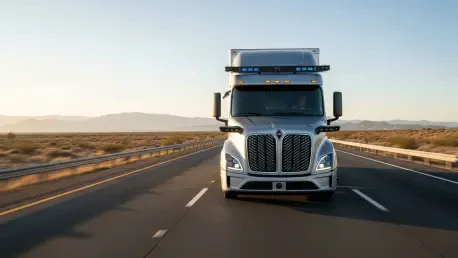

The sight of a forty-ton semi-trailer navigating a complex interstate interchange without a human behind the wheel is no longer a scene from science fiction but a rapidly approaching reality for American logistics. As the industry stands at this technological crossroads, the “Build America 250 Act” has emerged as a landmark bipartisan proposal from the House Committee on Transportation and Infrastructure to govern the nation’s highways from fiscal year 2027 through 2031. This five-year surface transportation reauthorization bill goes far beyond traditional road and bridge funding by introducing the first comprehensive federal regulatory framework for autonomous commercial motor vehicles. By establishing a unified national standard, the legislation seeks to dismantle the existing “patchwork” of conflicting state-level rules that currently hinders the seamless movement of goods across state lines. The goal is to create a predictable legal environment where innovation can flourish under the watchful eye of federal safety oversight.
This legislative shift is centered on the “Safe Integration of Autonomous Commercial Motor Vehicles” section, which provides the Department of Transportation with the explicit authority to manage the deployment of self-driving trucks. Currently, developers must navigate a labyrinth of varying regional mandates, a situation that industry experts argue creates unnecessary friction for long-haul logistics and complicates the scaling of autonomous fleets. By replacing these fragmented rules with a cohesive federal mandate, the bill aims to ensure that the United States remains a global leader in automotive technology while prioritizing public safety. The transition reflects a growing consensus that the future of freight requires a synchronized national approach to handle the unique complexities of driverless technology. This move toward standardization is seen as a vital step in transforming the American supply chain into a more efficient, technology-driven network that can meet the demands of modern commerce without compromising accountability.
National Safety Standards and Operational Requirements
Technical Compliance and Evidence-Based Safety
Under the proposed guidelines, the Secretary of Transportation is tasked with defining specific safety benchmarks for autonomous interstate commerce within a window of six months to two years. A cornerstone of this framework is the requirement for manufacturers to develop and maintain a rigorous “safety case,” which serves as a comprehensive body of evidence proving their systems are at least as reliable as a human-operated vehicle. This approach shifts the burden of proof directly onto the technology developers, requiring them to provide transparent, empirical data on how their software handles edge cases, such as extreme weather or sudden road obstructions. By mandating a safety-case model, the federal government ensures that “self-certification” is backed by verifiable engineering arguments rather than just marketing promises. This rigorous documentation must be updated continuously, reflecting the iterative nature of software development and ensuring that any updates to the autonomous stack maintain or improve the established safety profile of the fleet.
Furthermore, this evidence-based safety requirement creates a standardized language for evaluating risk across different platforms and hardware configurations. Instead of relying on a “one-size-fits-all” hardware checklist, the safety case allows for innovation in sensor suites and computing architectures as long as the performance outcomes meet the federal baseline. This flexibility is crucial for a rapidly evolving industry where today’s LIDAR technology might be replaced by more advanced imaging systems tomorrow. The legislation emphasizes that these safety benchmarks are not static; they must adapt as the Department of Transportation gains more data from real-world deployments. This dynamic regulatory environment encourages manufacturers to compete not just on the speed of their delivery, but on the robustness of their safety protocols. By grounding the approval process in hard data and formal logic, the bill seeks to build public trust in a technology that many still view with skepticism, providing a clear path for the commercialization of heavy-duty autonomous platforms.
Rulemaking and Digital Infrastructure Safeguards
Beyond the immediate mechanical safety of the trucks, the bill outlines several critical mandates focused on the digital and organizational infrastructure supporting these vehicles. It calls for the creation of a specialized transportation rulemaking committee, comprised of industry experts, safety advocates, and labor representatives, to offer ongoing technical recommendations to the Secretary. A major focus of this committee will be the implementation of robust cybersecurity plans designed to prevent, detect, and respond to potential digital threats that could compromise a vehicle’s control systems. As these trucks become increasingly reliant on cloud connectivity and over-the-air updates, the threat of malicious interference becomes a matter of national security. The legislation mandates that companies must have active threat-monitoring systems and clear protocols for “failsafe” modes in the event of a cyber breach, ensuring that a compromised vehicle can be safely sidelined without human intervention.
Operational safety is further reinforced through strict limits on the human-machine interface, specifically regarding the role of remote dispatchers. The legislation acknowledges that while a truck may be “driverless,” it still requires a level of human oversight from a centralized operations center. To prevent operator fatigue and cognitive overload, the bill sets mandatory maximums on how many autonomous vehicles a single remote assistant can monitor simultaneously. Additionally, the framework requires clear signaling standards to alert other motorists when an autonomous vehicle enters a “minimal risk condition.” This safe state is a programmed response to system failures, where the truck might pull onto the shoulder and activate specific lighting patterns to indicate it is no longer in active operation. These measures are intended to create a secure environment where digital safeguards and human oversight work in tandem to manage the inherent risks of automation, providing a structured response to technical anomalies before they escalate into accidents.
Navigating Human Oversight and Industry Conflict
Addressing High-Consequence Transport Scenarios
Despite the broad push toward full automation, the Build America 250 Act recognizes that certain transportation tasks carry risks that demand the presence of a human being. The legislation explicitly mandates that human operators must remain on board for autonomous or semi-autonomous school buses and any vehicles transporting placarded hazardous materials. These “carve-outs” reflect a measured and cautious approach to high-consequence transport, acknowledging that the margin for error is razor-thin when the lives of children or the safety of entire communities are at stake. While the technology may be capable of navigating a standard route, the presence of a trained professional provides a layer of intuitive problem-solving and emergency response that artificial intelligence cannot yet replicate. This decision underscores a philosophical stance within the bill: automation should enhance efficiency, but it must not override common-sense safety precautions in the most sensitive sectors of the transportation industry.
This targeted retention of human oversight serves as a strategic bridge between the fully manual past and the highly automated future. By identifying specific use cases where the risk of a system failure is unacceptably high, the House Committee is attempting to mitigate public anxiety regarding the total removal of human agency from the roads. These exceptions also provide a controlled environment for studying the interaction between autonomous systems and human supervisors in high-stress scenarios. Data gathered from these “hybrid” operations could eventually inform the safety standards for other sectors as the technology matures. For now, the requirement for a human presence in hazardous material transport ensures that if a leak or mechanical failure occurs, there is an immediate on-site responder capable of executing complex containment protocols. This balance between pushing technological boundaries and maintaining traditional safety pillars suggests that the federal government is more interested in a sustainable transition than a reckless rush toward full autonomy.
The Debate Between Innovation and Labor Protection
The introduction of this bill has exposed a deep ideological rift between the burgeoning autonomous vehicle industry and traditional labor organizations. Proponents of the legislation, including major technology developers and the Autonomous Vehicle Industry Association, view the bill as a vital milestone for American economic competitiveness. They argue that federal preemption of conflicting state laws is the only way to provide the “regulatory certainty” necessary to unlock billions of dollars in capital investment and scale the deployment of self-driving fleets. From their perspective, the current lack of a unified federal standard acts as a bottleneck that threatens to cede the lead in automotive innovation to international rivals. They contend that the Department of Transportation is the only entity with the expertise and authority to oversee the industry effectively, and that this bill provides the necessary tools to do so while fostering a climate of growth and technological advancement.
In stark contrast, organizations like the Owner-Operator Independent Drivers Association have voiced significant apprehension regarding the speed and nature of this transition. Their primary concern revolves around the “self-certification” model, which they fear allows manufacturers to grade their own homework without sufficient independent federal validation. Labor advocates argue that the deployment of driverless trucks could pose severe risks to public safety if the technology is not subjected to the same rigorous, third-party testing that human drivers must undergo. Beyond safety, there is the existential concern regarding the livelihoods of millions of professional drivers whose jobs could be displaced by artificial intelligence. This tension highlights a broader national debate about the social cost of efficiency and the role of the American worker in an increasingly automated economy. The conflict ensures that as the bill moves through the legislative process, the focus will remain on whether the proposed framework can truly protect the public while transforming the very nature of work in the logistics sector.
The legislative journey of the Build America 250 Act proved that the transition to autonomous trucking is as much a political and social challenge as it is a technical one. By attempting to codify federal rules for self-driving heavy freight, Congress signaled that the era of experimental “pilot programs” has ended, replaced by an era of permanent commercial deployment. Stakeholders must now look toward the implementation phase, where the Department of Transportation will need to hire specialized technical staff to evaluate the complex “safety cases” submitted by manufacturers. For industry players, the next logical step involves investing heavily in standardized data-sharing protocols to meet the bill’s transparency requirements while protecting proprietary algorithms. For labor and safety advocates, the focus should shift to ensuring that the rulemaking committees remain inclusive and that cybersecurity mandates are strictly enforced. As the September 30 deadline passed and the framework began to take shape, the emphasis remained on creating a resilient transportation network that utilized the strengths of automation without abandoning the safety and economic stability of the American public.