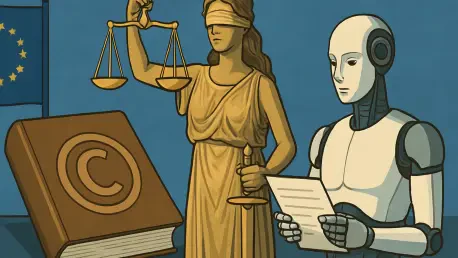

The existing legal framework established in 2004 was originally designed to harmonize patent and trademark procedures long before the advent of massive data scraping. Today, the rapid rise of Generative AI has forced a critical re-evaluation of how the European Union protects intellectual property. While the foundational framework for enforcement was established two decades ago through the Intellectual Property Rights Enforcement Directive, this aging legislation is now under intense scrutiny. As AI models ingest massive amounts of copyrighted books, music, and news to fuel their outputs, lawmakers are grappling with a fundamental tension. They must decide how to foster a competitive landscape for technological breakthroughs while simultaneously shielding the human creativity and cultural heritage that form the bedrock of the European economy. This modern landscape is marked by an effort to reconcile older legal concepts with current technological capabilities, creating deep uncertainty for both developers and the artists who fuel these systems.
Diverging Perspectives on Regulation and Policy
Within the European Parliament, a heated debate is unfolding over the best path forward, ranging from demands for strict transparency to more flexible, case-by-case approaches. Some advocates, such as MEP Axel Voss, push for a structured system of licensing and mandatory compensation to ensure creators are paid for their work. They argue that the era of unauthorized scraping must end to preserve the financial viability of European media and art. Conversely, others warn against rigid rules that might stifle innovation in critical sectors like public health and infrastructure where AI can offer life-saving advancements. This camp suggests that overly burdensome copyright restrictions could drive technology companies out of the European market, leaving the continent dependent on foreign entities for essential services. This ideological split creates a significant hurdle for any unified legislative update, as the balance between economic protectionism and technological progress remains elusive.
The economic stakes of intellectual property enforcement are substantial, as the rise of infringing platforms siphons hundreds of millions of dollars away from original creators and into the pockets of data scrapers. According to data from the EU Intellectual Property Office, websites facilitating IP infringement generated hundreds of millions in advertising revenue globally in the past year alone. This value gap represents a significant transfer of wealth from the creative industries to the technology sector, undermining the sustainability of professional journalism and the arts. When AI systems generate content that directly competes with the data they were trained on, the original creators suffer a double loss: the loss of control over their work and the loss of market share to an automated substitute. This economic imbalance is not merely a theoretical concern but a structural threat to the diversity of European culture. Without a mechanism to redirect revenue back to sources, the creative ecosystem faces a period of managed decline.
The Role of Judicial Precedents and Future Frameworks
As political discussions continue, European courts have emerged as the primary battleground for defining the boundaries of AI copyright. High-profile legal disputes involving tech giants like Google and Meta are already setting significant precedents regarding the unauthorized use of news content and artistic works. For instance, recent opinions in Hungarian courts suggest that AI chatbots retrieving news content to generate detailed answers may be infringing on the rights of original publishers. Similarly, the Paris Court of Appeal recently upheld rulings requiring major social media platforms to negotiate in good faith with media organizations over content usage. These judicial interventions are filling the vacuum left by legislative delays, effectively creating a common law of AI intellectual property. In Germany, the success of collecting societies against AI music generators has proven that technology cannot bypass protected musical compositions without facing tangible legal consequences in established courts.
To address these systemic challenges, the EU is attempting to weave together a complex tapestry of regulations, including the Digital Services Act and the landmark AI Act. These overlapping laws aim to create a more transparent environment by mandating that AI developers disclose their training data and comply with copyright standards. The AI Act specifically introduces requirements for general-purpose models, forcing them to provide summaries of the protected content used for training. This regulatory approach seeks to move away from a Wild West scenario toward an environment where accountability is built into the development lifecycle. By integrating transparency mandates with existing copyright protections, the European Union hopes to provide a predictable path for innovation. However, the effectiveness of these measures depends heavily on how they are harmonized and enforced across different sectors. The goal is to ensure that the digital economy rewards all participants fairly, rather than just those who control resources.
In light of these developments, stakeholders recognized that the path forward required a shift from reactive litigation to proactive, mandatory licensing frameworks. It became clear that the 2004 directive needed targeted updates to account for automated data ingestion and synthetic content generation. Moving forward, the European Commission should prioritize the creation of a centralized clearinghouse for AI licensing to simplify the remuneration process for small creators. Additionally, national governments must invest in judicial training to ensure that judges are equipped to handle the technical complexities of machine learning disputes. Investors and tech firms should adopt ‘copyright-by-design’ principles, ensuring that data provenance is tracked from the earliest stages of model development. By establishing clear standards for transparency and fair payment today, the European Union ensured that the next wave of technological growth did not come at the expense of its cultural foundations. This balanced approach offered a sustainable model for the global digital economy.